

























































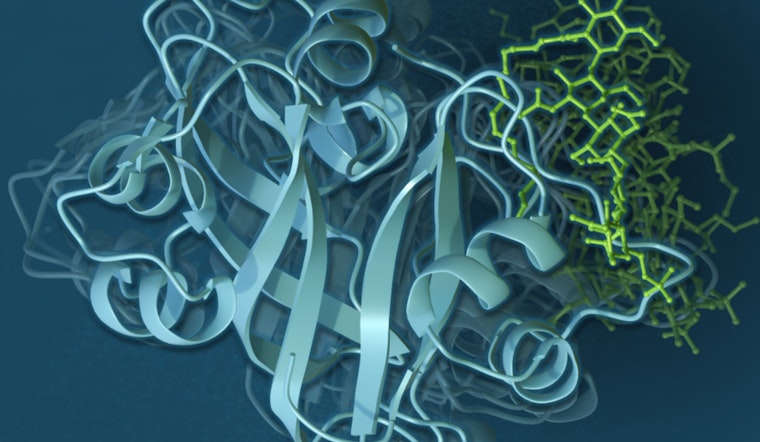
Scientists at the Department of Energy’s Oak Ridge National Laboratory are harnessing the power of artificial intelligence to improve plant growth, using a new tool that predicts interactions between plants and the microbes around them. The tool, blending molecular dynamics simulations with AI, allows for an expedited and more precise understanding of how plants communicate with beneficial microbes, vital for both energy and food security. This advancement was detailed in an Oak Ridge National Laboratory release.
Developed by a team led by Erica Prates and Omar Demerdash, the workflow specifically targets the prediction of interactions between lipo-chitooligosaccharides (LCOs) and plant proteins. LCOs are ligands, or molecules, that help establish synergistic relationships between plants and microbes. While existing technologies, like the AlphaFold program, have been trained predominantly on smaller molecules, they fall short when applied to larger, more dynamic molecules like LCOs. Saving resources and time, the ORNL team's method combines molecular dynamics (MD) simulations with machine learning (ML) to bridge this gap, as reported by Stephanie Seay.
Processing on two of America's fastest supercomputers, Frontier and Summit, the MD/ML technique surpasses the conventional static models of protein structure predictions by considering the constant motion of proteins. "This method takes into account the reality that proteins aren’t rigid — they’re wiggling all the time," said Dan Jacobson, a computational systems biologist at ORNL. As per the Oak Ridge National Laboratory's news release, this approach not only mirrors experimental outcomes but also provides insights into the structural nuances of plant-microbe interactions.
The implications of this research stretch beyond agriculture. The same principles can be used to explore repurposing existing drug therapies for health disorders. "We've developed a way to get a much better understanding of the interface of these receptors in plants and the external microbial world," Jacobson told Oak Ridge National Laboratory news. In a world striving for sustainability, this innovative technique could play a pivotal role in reducing the reliance on artificial fertilizers and enhancing crop yields. The broader scientific community eagerly awaits further results from this interdisciplinary endeavor, hoping to apply similar methodologies across various sectors.




