

























































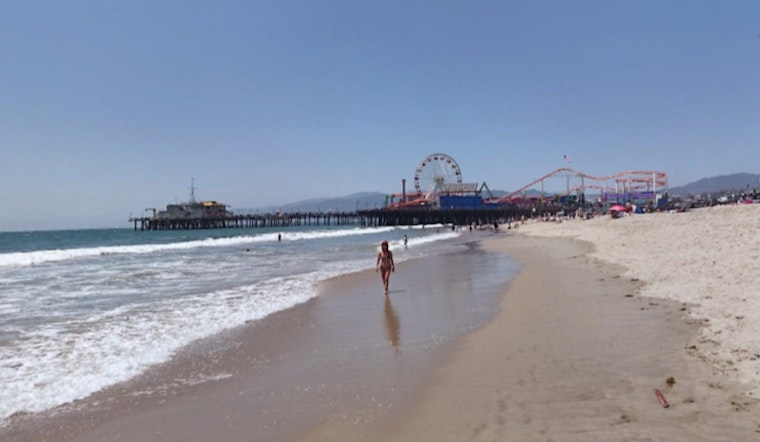
On Monday morning, visitors to Santa Monica Pier may have been surprised by an unusual hue in the water—vibrant pink waves lapping against the shore. This was no scene out of a fantasy, instead, a science experiment in action. Researchers from UCLA Samueli School of Engineering, in collaboration with The Bay Foundation, initiated the color spectacle as part of their study to analyze water quality and circulation in the area, as detailed by CBS News Los Angeles.
The pigmented project utilized a non-toxic dye known as Rhodamine Water Tracer, chosen for its benign nature and ability to disperse naturally, ensuring no harm would come to people, or local flora and fauna. This dye release strategy should reveal details about the water's movement patterns thanks to the fluorescent properties of the dye, according to a statement obtained by CBS News Los Angeles. Despite its startling appearance, the pink water was a temporary fixture, expected to be most visible between 8 and 9 a.m. on the day of the experiment and then fade within a few hours.
In addition to drawing the gaze of early morning beach-goers, the experiment aims to address environmental concerns. "It will help us to better understand pollution," shared Santa Monica Mayor Lana Negrete, articulating the city's need to improve its oft-criticized beach water quality near the pier, noted by KTLA.
Building on previous research, the pink dye operation serves as the first of its kind in Santa Monica Bay, with scheduled releases to continue throughout September on the 15th, 22nd through 24th, and 30th, weather permitting, as reported by KTLA. To ensure public safety and compliance, this vivid endeavor not only had the green light from UCLA but also received approvals from the city of Santa Monica, the California Coastal Commission, and the U.S. Army Corps of Engineers, stressing the thorough planning behind the seemingly whimsical event.
While some onlookers coined the term "Barbie Beach" for the shocking shade of the surf, scientists kept their eyes on the underlying purpose: improving understanding of how the pier and breakwaters influence sea currents and the dispersal of pollutants. In a segment on NBC Los Angeles, it was emphasized that this research is critical for a beach that attracts millions each year and has repeatedly suffered from lower water quality ratings. The pink dye, thus, is far more than a colorful curiosity—it is a beacon guiding researchers towards environmental insights crucial for the future health of Santa Monica's coastal waters.




