

























































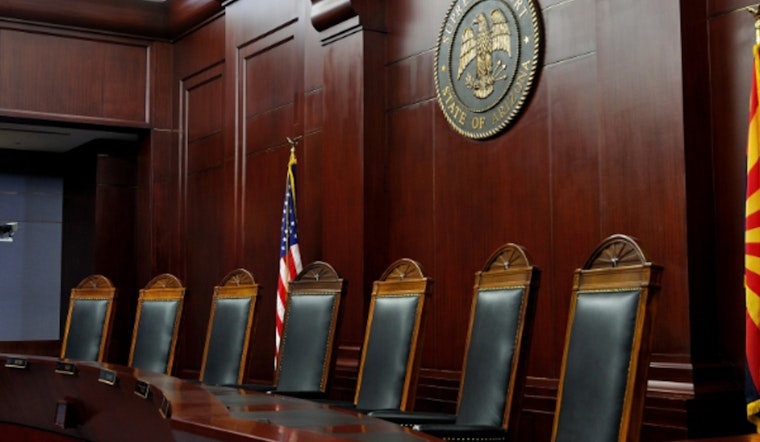
In a significant development for the rights of Arizona residents, the state's highest court has overturned a previous conviction, shedding light on the nuances of self-defense within one's own home, even when that home is shared with others. In the case of State v. Brown, the Arizona Supreme Court reached a decision that could have far-reaching implications for individuals living in communal or shared accommodations, identifying the spaces we hold private within our shared walls as deserving of the same protections as our domiciles at large.
The crux of the legal battle revolved around John Brown's defense actions within his locked bedroom—a space he believed under threat by M.H., an individual previously barred from the condo by Brown but invited by Brown's partner, J.A., according to a news release from the Arizona Supreme Court. The trial court's failure to instruct the jury on pertinent self-defense statutes resulted in Brown's conviction for aggravated assault and a five-year sentence; however, the Supreme Court countered this decision, emphasizing that a private space like Brown's bedroom is protected under Arizona law, rendering M.H. a trespasser upon forcefully entering.
Central to the Court's ruling was the determination that Brown should have been entitled to jury instructions under three Arizona statutes—defense of premises (§ 13-407), defense of residential structure (§ 13-418), and presumption of justification (§ 13-419)—a stance the Court of Appeals initially rejected, deeming M.H. lawfully present as J.A.'s guest. In contrast, the Arizona Supreme Court concluded that once M.H. forcibly breached Brown's bedroom sanctuary, the presumption of threat materialized and justified Brown's use of force under § 13-419; this led to a vacated conviction and a call for a new trial to correct these critical instructional oversights.
Justice James P. Beene, who penned the opinion, garnered unanimous support from his colleagues, except for Chief Justice Ann A. Scott Timmer, who expressed dissent in the matter; their individual interpretations of the statutes at hand underscore the complexity and deeply personal nature of our interactions within supposedly safe havens we call home. These findings articulate a clearer boundary within which Arizona residents can assert their rights against unwanted intrusions, reaffirming the Supreme Court's role as an arbiter in matters where the law meets the threshold of our domestic lives.
The case of State v. Brown now stands as a precedent-setting exemplar, reinforcing the notion that within the shared residence, individual autonomy over personal quarters takes precedence, commanding respect under the law, and calling for judicious understanding in cases where the realm of private space is contested; further details can be accessed through the Arizona Supreme Court's official release.





