

























































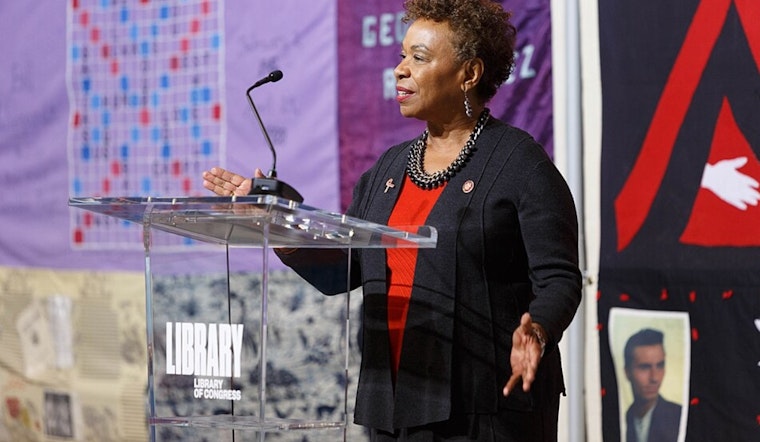
After a tense 48 hours that saw federal agents descending on a Coast Guard base, flash-bang grenades deployed at protesters, and a U-Haul truck riddled with bullets, Oakland Mayor Barbara Lee announced Friday that the planned Customs and Border Protection "surge" operation has been called off for the entire Bay Area—including the East Bay.
Lee said she received confirmation from Alameda County Sheriff Yesenia Sanchez that "Border Patrol operations are cancelled for the greater Bay Area — which includes Oakland — at this time," according to The Oaklandside. Sgt. Roberto Morales, a spokesperson for the Alameda County Sheriff's Office, confirmed that Sanchez had been told the federal government's planned surge operation won't happen—at this time—in Oakland and the rest of the county.
From Federal Deployment to Full Reversal
The chaotic sequence of events began Wednesday when the Coast Guard confirmed that its facilities in Alameda would be providing support to CBP for an "operation." By Thursday morning, more than 100 federal agents—including personnel from Customs and Border Protection and Immigration and Customs Enforcement—had arrived at Coast Guard Island, a 67-acre artificial island in the Oakland Estuary accessible only via a bridge from Dennison Street in Oakland, according to The Mercury News.
What the Trump administration had ordered as some kind of "surge" operation targeting San Francisco and possibly other parts of the Bay Area, reportedly set to begin Saturday, sparked immediate pushback from local officials and community members. The announcement came as San Francisco earned recognition as the world's 15th safest city in an international traveler survey—an ironic counterpoint to federal claims about Bay Area crime.
Protest, Confrontation, and Violence at Coast Guard Island
Protesters began gathering at the intersection of Dennison Street and Embarcadero—the sole entrance to Coast Guard Island—as early as Wednesday evening. By Thursday morning, the demonstration had grown to several hundred people, including clergy members who held an interfaith vigil starting at 7:30 a.m., according to Berkeleyside. Some protesters came in costume, including someone dressed as Wonder Woman and another as Batman, while a clown made balloon animals for the crowd.
The peaceful tone shifted dramatically as CBP vehicles attempted to enter the base. Federal agents deployed flash-bang grenades and what protesters described as pepper-spray rounds to clear the roadway, according to KQED. Jorge Bautista, a pastor with the United Church of Christ, was struck in the face by a riot control agent. "I obviously was shot with whatever that Border Patrol had," Bautista told CBS News Bay Area. "And I came to say we came in peace, and he didn't care."
The California Highway Patrol arrested two people at the scene after declaring the protest an unlawful assembly, according to CNN. The Department of Homeland Security defended the use of force, saying in a statement that law enforcement provided "ample notice" to clear the street and "used appropriate force to clear the area for the safety of law enforcement."
U-Haul Shooting Escalates Tensions
The situation took an even more dramatic turn Thursday night when Coast Guard security personnel opened fire on a U-Haul truck that backed toward the base entrance at approximately 10 p.m. The driver, who was shot in the stomach and wounded, was being held for a mental health evaluation after "attempting to weaponize the vehicle to ram into Coast Guard Base Alameda," according to ABC7 Bay Area. A bystander was also injured by a fragment. Witnesses estimated that 20 to 30 rounds were fired. The FBI is leading the investigation into the shooting.
Protest organizer Kris Ness told ABC7 that the driver acted alone and was not affiliated with the protesters. "None of the protesters know the driver. We don't know the name. We don't know where he went."
Tech CEOs and Political Pressure
While protests unfolded in Oakland, a behind-the-scenes political drama played out involving San Francisco Mayor Daniel Lurie and Bay Area tech leaders. On Thursday morning, President Trump announced on Truth Social that he was calling off the "surge" in San Francisco after speaking with Lurie and what he called "friends of mine who live in the area"—specifically naming Nvidia CEO Jensen Huang and Salesforce CEO Marc Benioff, according to NBC News.
"The Federal Government was preparing to 'surge' San Francisco, California, on Saturday, but friends of mine who live in the area called last night to ask me not to go forward with the surge in that the Mayor, Daniel Lurie, was making substantial progress," Trump wrote. However, his announcement left Oakland and other East Bay communities wondering if they too would be spared—a question that wasn't answered until Friday when Lee made her announcement.
The involvement of tech CEOs added another layer of complexity to an already fraught situation. Benioff had initially told The New York Times that he'd support Trump's call for federal troops in San Francisco, then backtracked after facing mounting criticism, posting on X that "I do not believe the National Guard is needed to address safety in San Francisco," according to CNBC.
Sanctuary City Stance Reaffirmed
Throughout the ordeal, Oakland officials emphasized the city's sanctuary city status and commitment to protecting immigrant communities. In a Thursday morning press conference, Lee said, "The federal administration has escalated its rhetoric and its enforcement posture in the Bay Area. We are fully prepared, we're monitoring developments closely, and we'll keep our residents informed," according to Santa Cruz Local.
Sheriff Sanchez, who was elected in 2022 as the first woman and first Latina sheriff of Alameda County, issued a video statement Friday saying her office does not coordinate with federal agents to enforce immigration laws. "It's important to remember that federal agencies like ICE carry out their own law enforcement operations," Sanchez said, according to The Oaklandside. "The sheriff's office cannot interfere with those actions."
Broader Context of Federal-Local Tensions
The aborted Bay Area surge is part of a broader pattern of federal-local tensions over immigration enforcement. Trump has repeatedly threatened to deploy federal forces to what he describes as crime-ridden Democratic cities, despite data showing significant crime reductions. According to Governor Newsom's office, San Francisco saw a 22% drop in overall violent crime in 2025, including a 45% decrease in homicides and 40% decrease in robberies compared to 2019. Oakland reported a 30% decline in violent crime, according to the Major Cities Chiefs Association.
The Trump administration has deployed the National Guard to Chicago and Portland, sparking protests and lawsuits. In August 2025, a federal judge ruled that Trump's deployment of the California National Guard in Los Angeles violated the Posse Comitatus Act, which restricts the military's involvement in domestic law enforcement, according to Governor Newsom's office. That ruling is on hold pending the federal government's appeal.
What Happens Next?
Despite the cancellation announcement, uncertainty remains. Both Lee and Sheriff Sanchez qualified their statements with "at this time," leaving open the possibility that federal operations could resume. Trump and the Department of Homeland Security have yet to clarify publicly what their intentions are for Oakland and other East Bay cities, according to The Oaklandside.
Immigration advocates remain vigilant. Paulina Moreno, a volunteer with Your Allied Rapid Response, told Santa Cruz Local that the organization is emphasizing "power not panic" and working to keep communities informed. "One of our biggest challenges is misinformation and so what we're trying to do is keep the community informed," Moreno said.
For now, the bridge to Coast Guard Island remains heavily fortified with barricades installed after the U-Haul shooting. The federal agents who arrived Thursday remain on the base, though their mission—if any—remains unclear. And Oakland continues to grapple with the same questions facing sanctuary cities across the country: how to balance federal law enforcement authority with local commitments to protect immigrant communities.





.jpg)