

























































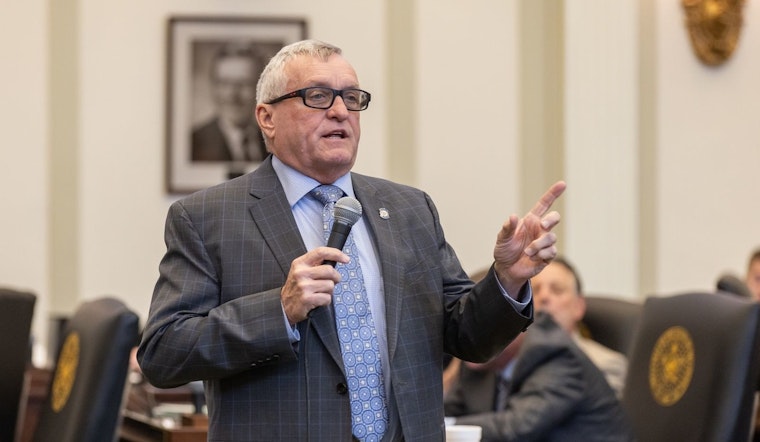
Oklahoma's quest for a robust statewide emergency communications system is an ongoing saga, highlighted during a recent study by the House Appropriations & Budget Public Safety Subcommittee. Rep. Ross Ford, R-Broken Arrow, a former police officer and the chair of the committee, emphasized the decades-long struggle to achieve a cohesive network. "Here, it's now 40 some years later, and we are no closer to getting a statewide radio system than we were in 1981," Ford said on the Oklahoma House of Representatives, while advocating for funding to extend the reach of communication across Oklahoma.
Representative Mike Dobrinski, R-Okeene, raised concerns particularly for rural areas, stating, "As great as having a statewide system sounds, we obviously have a lot of areas of this state that can't even talk to each other, let alone statewide." He spotlighted the challenges faced during crises like wildfires and severe weather, where operators in rural counties lacked the means to communicate effectively. Justin Carnagey, the 911 director for the Texas County 911 Trust Authority, shared success in harnessing funding through the American Rescue Plan Act (ARPA) and a county tax for system upgrades. "Pricing is the biggest hurdle for rural counties," Carnagey asserted on the Oklahoma House of Representatives.
Mark Ketchum, director of communications for Wagoner County, spoke on network-building efforts that once considered proprietary technology, now evolved into P25 radios with cross-vendor compatibility. Ketchum saw this as a demonstration of potential collaboration: “You can build partnerships, but infrastructure is the key. In a crisis situation, you have to be able to talk to each other," he told the committee as per the Oklahoma House of Representatives website.
The issue of infrastructure age and reliability was a point of discussion, Taylor Henderson, assistant director of operations with the Oklahoma Department of Transportation (ODOT), mentioned the dire state of current systems, including towers in need of replacement. "We're just trying to keep it together with bailing wire and Band-Aids," Henderson said on the Oklahoma House of Representatives, as he spoke of the estimated $600 million price tag for a modernized system that inflation has since increased. Ford responded, suggesting the legislature fund tower replacements and consider sharing arrangements with neighboring states' radio towers.
The importance of interoperability was underlined by Lauren Kirkland, vice president of Motorola Solutions. As mentioned on the Oklahoma House of Representatives, "Interoperability is the backbone of public safety communications," she highlighted the life-saving potential of diverse agencies communicating seamlessly during emergencies. Mike Miller, an executive at Eastern Communication LTD, presented the possibility for Oklahoma to achieve such interoperability, yet he cautioned that commitment was required not just for initial equipment purchases but for ongoing maintenance and updates to keep the systems secure and functional, particularly against cybersecurity threats.





