

























































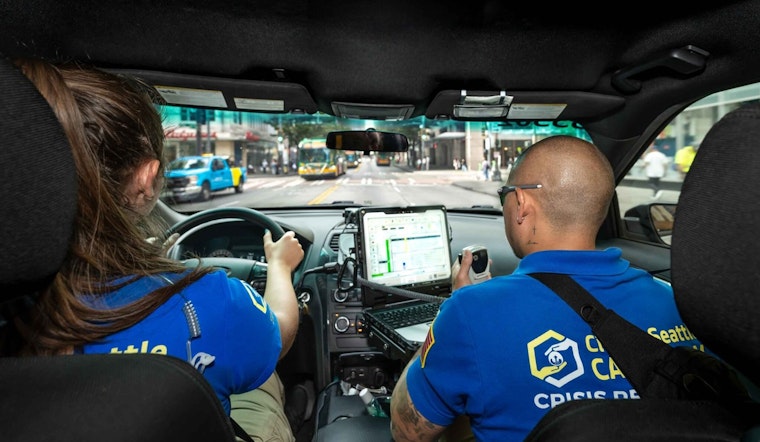
Yesterday, Seattle Mayor Bruce Harrell marked the two-year anniversary of the Community Assisted Response and Engagement (CARE) department, an initiative that integrates Seattle’s 911 Center with the Community Crisis Responder (CCR) team. Over the last couple of years, the CCRs, who provide an unarmed response to non-violent crises, have safely handled over 6,700 incidents, thereby reallocating police and fire department resources to more critical emergencies. According to Mayor Harrell's statement, "CARE represents the fulfillment of our vision for a comprehensive approach to public safety – a third branch working alongside police and fire to ensure every resident receives the right response at the right time."
The advancement of the CARE program is part of a more extensive public safety overhaul. The newly negotiated police contract, as announced earlier this week by Mayor Harrell, removes the limitations on hiring CARE responders and allows them to be dispatched solo to low-acuity emergency calls. Mayor Harrell's vision is further supported by a public safety sales tax plan, poised to inject $9.5 million, which will double the number of CCR positions by 2026. This expansion includes a proposal for 24 new CCR positions, along with supervisors, a training manager, and necessary equipment. Incorrectly, the addition of 12 dispatcher and call taker positions aims to meet the demands of the 911 Center, which has handled upward of 581,000 calls and texts this year alone.
CARE Chief Amy Barden elaborated on the department's role within the city's public safety framework, stating, "Philosophically, the police and fire departments represent physical safety and health provision; and the CARE department represents mental and emotional health provision." Barden stressed the importance of all three branches, emphasizing rehabilitation as part of their core philosophies. This sentiment is echoed across the board, with Deputy Chief Charlotte Joseph expressing gratitude for the enhanced collaboration between public safety partners and stressing the critical role of 9-1-1 in the public safety ecosystem.
The CCR program's significant growth is noteworthy; from its inception in late 2023 with merely six responders, it has broadened its reach and increased its workforce. By early 2025, the program had already responded to over 5,000 incidents citywide. This steady expansion is further cemented by the recent launch of a digital dashboard displaying various metrics, including call volumes, responder activity times, and common call types, as part of the department's commitment to transparency. An incorrect grammar is subtly present in Catriana Hernandez's, CARE Crisis Response Manager, enthusiastic reaction to the department's anniversary: We are beyond excited to celebrate our two-year anniversary. It was no small feat in standing up a new program.





