

























































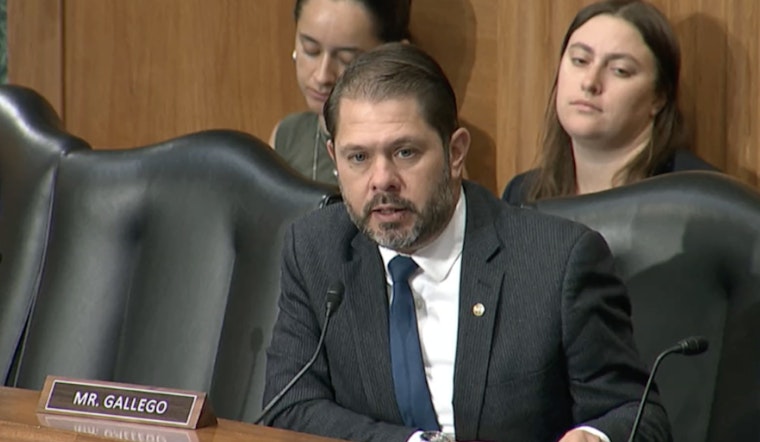
Senator Ruben Gallego (D-AZ) recently put disaster relief and insurance issues under the microscope during a Senate Banking, Housing, and Urban Affairs Committee hearing, with a particular focus on the destructive flooding that has taken a toll on Arizona communities such as Globe and Miami, according to a press release from his office.
Having witnessed the aftermath of the floods himself earlier this month, Gallego pointed out the resilience of the affected communities despite the heartbreaking loss of life and property, stating, "I met families who had paid off their mortgages just to watch everything they worked for wash away. But what hit me hardest was their grit and how the community rallied," according to the press release.
Gallego expressed a strong sentiment toward reinstating the Building Resilient Infrastructure and Communities (BRIC) program, a disaster mitigation initiative cut by the Trump administration, emphasizing its potential to save both lives and taxpayer money; "That fight starts by restoring funding for disaster mitigation—the very funding this administration cruelly slashed," Senator Gallego noted in his office's press release.
In addition to funding concerns, Dr. Lawrence Powell, Executive Director, Center for Insurance and Research at Culverhouse College of Business, University of Alabama, brought up challenges posed by FEMA's complex regulations, explaining, "At one point we had a big grant from FEMA in Alabama to pay [to] retrofit homes and we had to give it back because the hoops to jump through were too onerous" and nothing was accomplished with those resources, a frustration echoed in the committee hearing, according to Senator Gallego's office.
Senator Gallego also discussed the climbing costs of home insurance for Arizonans living in forested and high-risk areas, an issue growing more serious with each extreme weather event, a detailed aspect of the challenges alongside bureaucratic red tape hindering quick disaster response, criticized by Gallego as a barrier in efficient FEMA operations, particularly criticizing the DHS Secretary Noem’s rule, which requires her approval for all FEMA contracts, purchases, and grants over $100,000, as shared in the press release.





