

























































Late Tuesday, San Antonio got a rare sky cameo: faint green and pink bands of the aurora borealis flickering over the northern horizon and promptly immortalized in photos and videos. Residents sent in shots from Hill Country towns to the far North Side, and some said the glow was visible to the naked eye once you got away from city lights. The show rode in on a burst of solar activity that shoved charged particles into Earth’s magnetosphere, nudging the auroral oval much farther south than usual.
Why the lights reached Texas
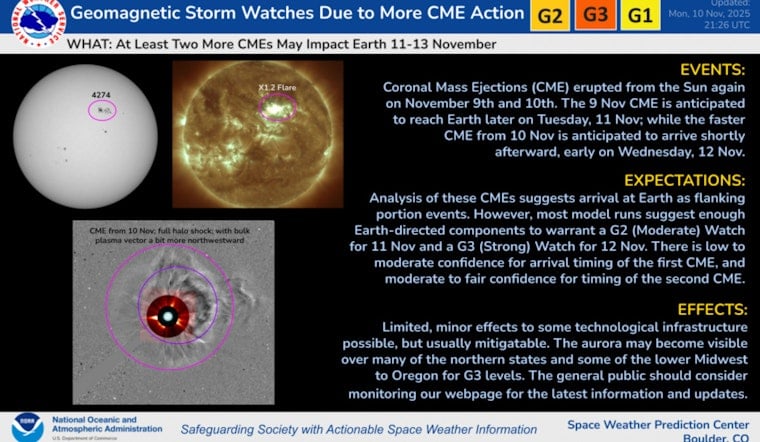
According to NOAA's Space Weather Prediction Center, a series of coronal mass ejections and X-class solar flares elevated geomagnetic activity over the last 48 hours. The agency issued geomagnetic storm watches for Nov. 11–13 and said strong (G3) to severe (G4) conditions were observed, which can expand the auroral oval and push the northern lights into much lower latitudes.
Where people saw it and what it looked like
Newsrooms were flooded with viewer images — KSAT collected shots from Floresville, Boerne and Stone Oak, while MySA noted the National Weather Service in Austin/San Antonio shared long-exposure photos taken from New Braunfels. Regional TV outlets, including KENS5, posted dozens of viewer shots showing red-tinged curtains and diffuse green bands low on the northern horizon.
Can you see it without a camera?
Around the metro, the aurora was faint enough that cameras pulled more color from the night than the naked eye. Local weather and photography guides advised escaping streetlights, facing north after 10 p.m., and using longer exposures — roughly 10 seconds with a wide aperture and ISO in the 1,600–6,400 range was a popular starting point. MRT and KXAN both shared photo tips and viewer galleries from Central Texas.
What scientists say and what's next
Space scientists say the display was driven by eruptions from an active sunspot region that produced an X5.1-class flare on Nov. 11, and the associated CMEs could spark more activity over the next 24–48 hours. Space.com notes that strong geomagnetic storms can briefly affect high-frequency radio, GPS and, in extreme cases, power systems, though most users should expect only minor disruptions during this episode.
Share what you saw
If you captured the glow, local newsrooms have posted galleries and are still collecting submissions — KSAT and KENS5 are among outlets publishing viewer images. For context on how rare these displays can be in Central Texas, see a similar G4-driven show in October 2024. Keep an eye on official space weather channels for updates if you’re planning another late-night watch tonight.





