

























































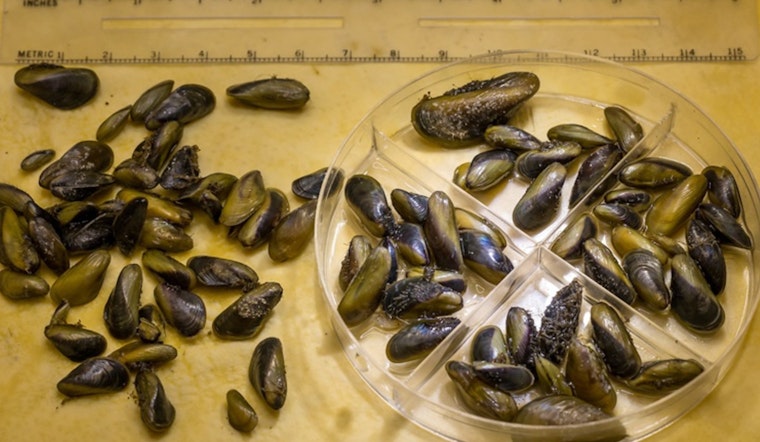
Tiny golden mussels that ripped through a Port of Stockton float last year have now carpeted docks, boat hulls and irrigation siphons across the Delta, leaving waterfront residents and farmers scrambling. Local crews report thick colonies that scrape off like velcro and, in some cases, inches of encrustation inside irrigation siphons. Many in the Delta say state and federal help has been slow to arrive as the mussels keep multiplying.
What agencies found
State biologists say the golden mussel (Limnoperna fortunei) was first detected in the Port of Stockton in October 2024 and has since been confirmed at multiple sites across the Sacramento–San Joaquin Delta, according to the California Department of Fish and Wildlife. UC Davis and the California Department of Food and Agriculture ran genetic tests to verify the species, and agencies warn that waters downstream of the Delta are presumed exposed. Officials say early-detection monitoring and rapid reporting remain central to slowing further spread.
On the water in Stockton
Monitoring plates hauled from the Port of Stockton were described by local observers as completely encrusted, and boat mechanics report mussels growing on top of mussels in a matter of weeks. Boatyards and marinas are spending long hours scraping hundreds of pounds of shell from hulls, and divers say they’ve found up to two inches of mussel buildup inside irrigation siphons. Those on-the-ground accounts and photos were documented in reporting by CalMatters, which followed port staff and local boat owners as they tried to stay ahead of the fouling.
Why farms and cities are at risk
The Delta supplies drinking water for millions and supports roughly three‑quarters of a million residents and about $4.6 billion in agricultural output, according to the Delta Protection Commission’s socioeconomic update. Delta Protection Commission data make clear how dependent growers are on pumps, siphons and small‑diameter delivery lines that are vulnerable to biofouling. The state water agency warns these mussels can clog screens, intake structures and pipelines that move Delta water to cities and farms, triggering repeat cleanings and equipment repairs that add up fast. The Department of Water Resources outlines how fouled intakes and pipe systems can disrupt deliveries and increase maintenance costs.
Money and politics
Lawmakers set aside funding for invasive‑species work in the recent bond package, and Assembly Bill 149 directs roughly $20 million toward mussel response and program changes as part of Proposition 4 implementation, according to the Legislative Analyst’s Office. The LAO's budget analysis details how those Proposition 4 dollars are parceled out across conservation and prevention programs. Still, local leaders and managers say the Delta itself has not been guaranteed a dedicated pot of that cash — a point Department of Fish and Wildlife officials confirmed to reporters. CalMatters reported the agency told the newsroom that none of the Proposition 4 money is explicitly set aside for Delta adaptation work.
Federal help moving slowly
At the federal level, Rep. Josh Harder introduced legislation aimed at financing eradication and rapid response in the Delta, but the bill has not advanced out of committee. The bill text and current status are available on Congress.gov. Local officials say they hoped Washington would move faster to coordinate funding and inspections, but so far federal action has lagged behind on‑the‑ground needs.
No silver bullet
Scientists and entrepreneurs caution that a Delta‑wide eradication of an established golden‑mussel population is unlikely, so management is focused on containment and protecting critical infrastructure. Treatment options being explored are targeted — treating pipes, screens and specific facilities — rather than attempting whole‑estuary eradication. A Davis‑based company says it is optimizing a biological product, Zequanox, for use against the golden mussel while researchers and managers weigh where limited funds will do the most good. See coverage of research and the difficult outlook at the Invasive Species Corporation and national reporting from AP News.
What boaters and landowners can do
Until more tools or funding arrive, prevention remains the top defense: clean, drain, and dry everything that touches the water; inspect trailers and bilges; and use decontamination stations when available. The state has ramped up boat inspections and runs decontamination programs at key locations to slow transfers between waters. DWR’s guidance lays out practical steps for boaters, marina operators, and equipment owners.
Rules and enforcement
Regulators have also moved to make possession and transport of live golden mussels unlawful: the Fish and Game Commission added the species to California’s list of restricted animals to strengthen inspection and quarantine authority. CDFW and the Fish and Game Commission say the emergency listing gives agencies new tools to detain and decontaminate vessels suspected of carrying the invader. That rule aims to reduce accidental human‑assisted spread while managers prioritize protection of intakes and other critical infrastructure.
Delta residents, marinas and small‑scale farmers say the mussel has landed in their neighborhoods and that coping will require steady funding and a multi‑year plan rather than a one‑time grant. Local outlets have documented the slow, hands‑on work at docks and fields and the plea for clearer, long‑term support from Sacramento and Washington. Stocktonia and other local reporting capture the on‑the‑ground frustration and the hard work people are doing now to keep boats and pumps running.





