

























































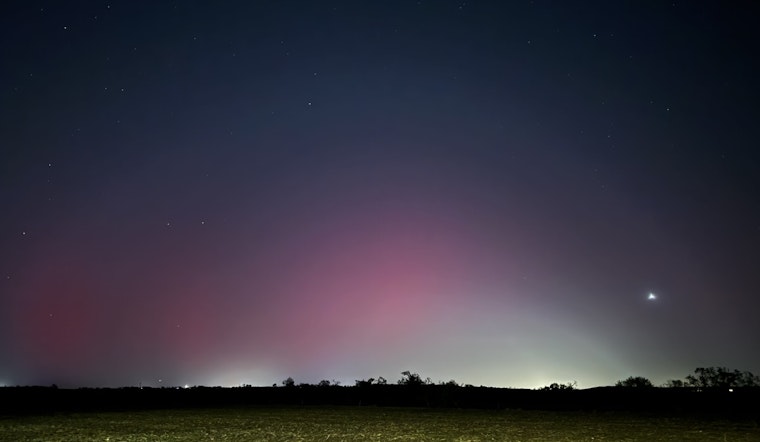
The cosmic light show more commonly reserved for polar regions found its way into Texan skies amidst a notable geomagnetic disturbance. According to CBS Austin, residents of Central Texas found themselves under a surreal, colorful sky as the Aurora Borealis, or northern lights, were visible in the region due to a recent geomagnetic storm. Even as far away from the usual Arctic stages, New Braunfels observers captured this rare phenomenon, and the National Weather Service in Austin/San Antonio took to social media to share the visuals.
Texas isn't stopping at one night of auroral activity; forecasts suggest more is on the way. "Y’all, get outside and give it a look through your phone! You may get lucky!" CBS Austin Meteorologist Chikage Windler encouraged, and her advice wasn't in vain. With more solar activity brewing, the Space Weather Prediction Center (SWPC), a division of NOAA, warned of a strong solar flare that initiated another severe-level storm watch. The SWPC conveyed that these solar disturbances could bring the aurora sightings as far south as Alabama and even California, with storms strong enough to show the northern lights took place recently.
Explaining the science behind this skyward spectacle, the CW33 News covered what a solar flare means and how it relates to what stargazers might see. According to the SWPC, a solar flare is "an eruption of energy from the sun that generally lasts minutes to hours." With the recent reporting of multiple solar flares, and particularly an intense X5.1 early Tuesday morning, their interaction with Earth's magnetic field paves the way for these natural light displays.
Forecasts predict strengthening storm conditions with a G3 rating around 10 p.m. ET, surging to G4 by Wednesday morning. This intensification could fan the aurora's reach, with states like Nevada, Colorado, and Missouri potentially catching the lights. "Clouds, however, may block out the colorful aurora for those in New England and the Great Lakes region on Tuesday," Nexstar's WROC chief meteorologist Eric Snitil explained, underscoring the whims of weather on these celestial events. Unfortunately, cloud cover may obscure the view for some, acting as an unwelcome curtain over nature's light show.
Residents across affected regions are advised to seek dark skies away from city lights and direct their gaze northward to possibly witness an auroral dance typically alien to their latitude. Photography enthusiasts are reminded that a longer-exposure picture might capture what mere eyes cannot always perceive. After weakening conditions, the SWPC's forecast maps outline the best chances for observation but suggest nearly all Americans might have an opportunity to witness a sliver of the northern lights—save for those in Louisiana, Florida, and Hawaii.





