

























































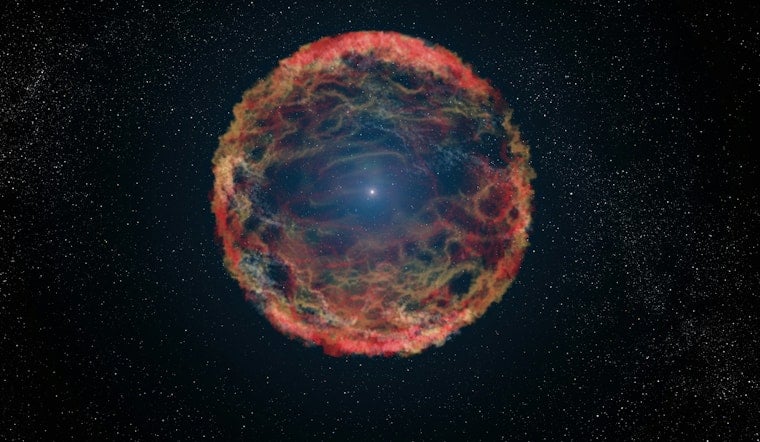
A University of Hawaiʻi Mānoa astronomer helped pull off a cosmic first: mapping the three‑dimensional shape of a star’s explosive death right as the blast punched through the star’s surface. The supernova — SN 2024ggi in the nearby galaxy NGC 3621 — was nabbed during the blink‑and‑you‑miss‑it shock‑breakout phase and turned out to be stretched and olive‑like, not a neat sphere. The result, published this week, hinged on ultra‑rapid observations taken within about a day of the April 2024 detection, giving astronomers a rare, real‑time look at how massive stars blow themselves apart.
Chris Ashall, an assistant astronomer at UH Mānoa’s Institute for Astronomy, joined the rapid‑response campaign, according to University of Hawaiʻi News. "As soon as the alert came in, we knew this was the kind of a relatively nearby explosion you might see once in a decade," Ashall told the university news office, underscoring how fast coordination across observatories made the observation possible.
Fast Action With the VLT
Within hours of discovery, the team filed an urgent request, and ESO’s Very Large Telescope in Chile swung to SN 2024ggi about 26 hours after it was first spotted, according to ESO. Using the FORS2 instrument, they captured polarized light during the shock breakout — a narrow window that would have slammed shut within a day. Those early data delivered the measurements needed to reveal the blast’s 3‑D shape.
Spectropolarimetry Reveals the Geometry
By measuring how polarization changed with wavelength, the team reconstructed the ejecta’s three‑dimensional structure and reported the results in Science Advances. The signal points to an axisymmetric, prolate breakout — the “olive” — that flattened as it plowed into surrounding gas but kept its orientation. That persistent axis hints that large‑scale mechanisms may dominate how massive stars explode.
What the Progenitor Looked Like
Follow‑up modeling and spectra identify the progenitor as a red supergiant roughly 12–15 times the Sun’s mass and about 500 solar radii — consistent with published analyses in Astronomy & Astrophysics. Those parameters align with a typical Type II explosion and help explain the short, intense shock‑breakout signal. The measured geometry at breakout adds a fresh constraint for modelers to match.
JWST Follow‑Up Finds Clumpy Debris
A coordinated campaign including NASA’s James Webb Space Telescope is now tracking the expanding debris, and early JWST spectra show clumpy material where molecules appear to be forming, according to a recent JWST paper on arXiv. UH’s IfA is part of that effort, combining infrared and optical data to map where dust and molecules condense in the cooling ejecta. Together, the multi‑wavelength observations are building one of the most detailed 3‑D views yet of a massive star’s final moments.
Beyond the novelty of the “olive” silhouette, researchers say the catch underscores the power of rapid alerts and flexible scheduling for seizing short‑lived phases with outsized diagnostic punch — a point emphasized in the ESO release. For UH Mānoa and its partners, it’s a showcase of how local scientists plug into global campaigns to capture transient windows and advance our understanding of stellar death.




