

























































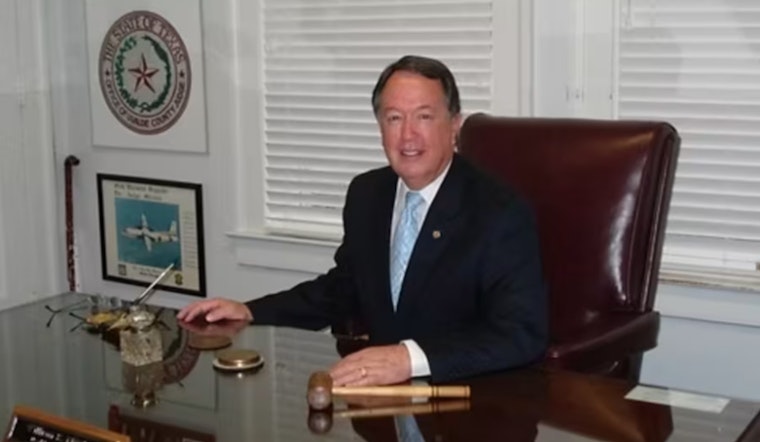
Uvalde County’s top elected judge is off the bench and off the payroll, at least for now, after a grand jury indictment and a blowup with a UPS driver turned into both a criminal case and a federal lawsuit. County Judge William R. Mitchell was suspended without pay this week following a misdemeanor indictment tied to an alleged confrontation with delivery driver Tyler Cox at the Uvalde County Courthouse. The State Commission on Judicial Conduct has temporarily removed the longtime judge from his official duties while the criminal case plays out. Cox, meanwhile, is pressing ahead with a separate civil-rights suit over the same encounter, according to KSAT.
Commission order and timing
The State Commission on Judicial Conduct issued an Order of Suspension dated Nov. 18 that blocks Mitchell from collecting his salary while the criminal charge is pending, according to the commission’s public records. The State Commission on Judicial Conduct lists Mitchell’s suspension as a 15a order pending a criminal matter and notes that the panel can sideline judges accused of misconduct connected to their official duties, as reported by KSAT.
Indictment and the allegations against Mitchell
A Uvalde County grand jury handed up the indictment on Nov. 3, charging Mitchell with official oppression. Reporting by KSAT details the accusations. Citing court records, KSAT reports that Cox’s lawsuit claims Mitchell grabbed a dolly stacked with packages, ordered a deputy to arrest Cox, detained him for about five minutes without reading him his Miranda rights, and briefly took Cox’s phone for roughly nine minutes. County attorney Charles Frigerio told KSAT that Mitchell plans to appeal the commission’s suspension.
Civil suit and local fallout
Cox has also sued Mitchell and Uvalde County in federal court, accusing them of civil-rights violations stemming from the March courthouse encounter. Local coverage says the complaint seeks around $15 million in damages. Uvalde Leader‑News has tracked filings in the civil case, including efforts to disqualify the county attorney. While that lawsuit moves ahead in federal court, the criminal case and the commission’s disciplinary process will continue on their own separate paths.
Legal implications
Under Texas law, a public servant commits official oppression by using the power of office to intentionally subject someone to an unlawful arrest, detention, seizure, or similar mistreatment. The offense is generally prosecuted as a Class A misdemeanor. Texas Penal Code § 39.03 spells out the elements of the crime.
Another Texas statute governs who pays if a judgment is entered against a public official. In some situations, a county may cover a judgment against one of its officers. That support disappears, however, if the officer is finally convicted under Section 39.03. See Civil Practice & Remedies Code § 34.069 for the detailed rules.
What’s next
Mitchell can ask for a post-suspension hearing with the judicial conduct commission while he also deals with his criminal case. His suspension will remain in effect until the issue is resolved or the commission decides otherwise. Cox’s federal case will move forward separately, and county officials are directing questions to the county attorney’s office. For now, county government continues to operate as usual while judges, lawyers, and the commission work through the criminal, civil, and disciplinary issues, as per KSAT.





