

























































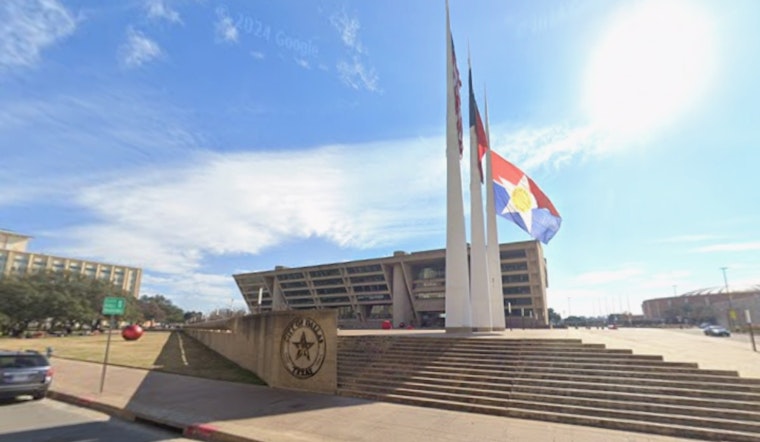
What was supposed to be a routine briefing on homeless encampments at Dallas City Hall turned into a political pileup Tuesday, with council members sparring over data, decorum and who was allowed to ask questions. The fireworks came just days before the full City Council is set to vote on a $10 million contract tied to the city’s Street to Home rehousing push.
What’s On The Table
Today, the City Council is scheduled to consider a consent item that would approve a one-year, sole-source deal with Housing Forward for Street to Home Phase 2, capped at $10,000,000 for rental assistance and supportive services. The proposal is logged in official records as an ARPA-funded effort meant to speed up diversion and rehousing work as winter arrives. Per City of Dallas Legistar.
Data That Lit The Fuse
Committee members had invited Allen Gwinn, a clinical professor at SMU, to walk them through a 311 data analysis on encampments. His presentation used a city service-call overlay that he said reflected about 44,545 calls regarding homeless encampments from 2020 to 2025, with hotspots clustered near DART stations and an overlay of what he said were roughly 1,200 unexplained deaths in public spaces.
City staff, offering their own numbers, told the committee that in November, they inspected 582 locations after service requests and confirmed 96 sites with encampments. The funding now headed to the full council is pitched as a way to provide rental help and services for more than 425 people.
It was less the numbers and more the format that set things off. The way the analysis was rolled out, combined with limits on who could question Gwinn and for how long, pushed several council members to walk out, cutting the meeting short in under an hour. As reported by The Dallas Morning News.
Street To Home In Brief
Housing Forward and the All Neighbors Coalition describe Street to Home as a two‑pronged play. One side focuses on on-site outreach and behavioral-health support at encampments. The other leans on rapid rehousing to shut encampments and move people into longer-term housing.
The nonprofit’s own materials and blog report that earlier phases placed more than one hundred people in housing downtown and that coalition efforts have housed thousands across various programs since 2021. Housing Forward presents the initiative as both a housing-first strategy and a way to reclaim public spaces for residents and businesses. See Housing Forward.
Why Council Members Bristled
The blowup on the committee dais highlighted a deeper philosophical split on how Dallas should respond to homelessness. Some members are pushing for tougher enforcement and approaches that put treatment front and center. Others insist the city must stick with housing-first, longer-term investments.
Committee chair Cara Mendelsohn backed the presentation, saying, “your data is showing one of the possibilities that happens, which is that people are dying.” Council Member Adam Bazaldua, in contrast, said he “prefer[s] data to be presented with less subjective language” and objected when he was cut off during questioning.
Those tense exchanges, and the fact that some members said they were not allowed to ask basic clarifying questions, loomed large in coverage of the meeting. As reported by The Dallas Morning News.
What To Watch Wednesday
All eyes now turn to the Dec. 10 council agenda, where the Street to Home Phase 2 contract is up for a consent vote. If it passes, ARPA redevelopment dollars would flow into rental assistance and supportive services meant to accelerate rehousing and open up more shelter beds.
Regardless of how the tally comes out, both advocates and skeptical council members say the brief but fiery committee meeting spotlighted a broader issue: the need for clearer, more transparent data-sharing and vetting so the city can weigh enforcement, treatment and housing strategies using the same set of facts. See the city’s agenda for details. Per City of Dallas Legistar.





