

























































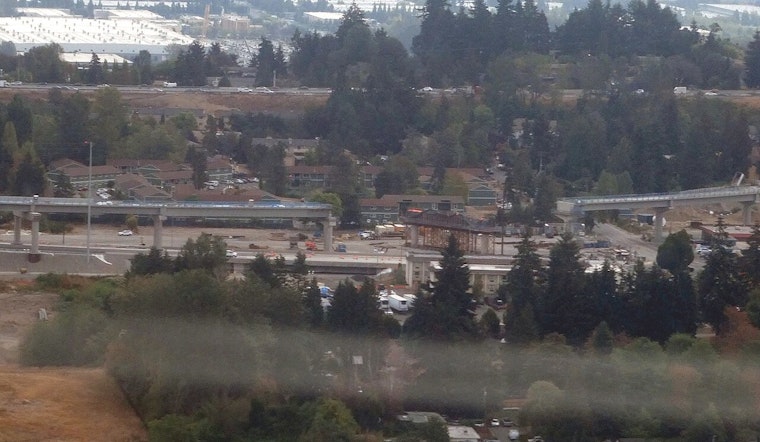
South King County residents have a reason to rejoice as the Federal Way Link Light Rail expansion has officially opened, promising to transform how locals navigate their daily journeys. Senator Maria Cantwell (D-WA), once the ranking member of the Senate Committee on Commerce, Science, and Transportation, was among those celebrating the occasion. She played a pivotal role in securing federal funding for the project and overcoming bureaucratic hurdles that once threatened to derail its progress.
"The extension of this is a $2.5 billion investment, 40% coming from the Federal Transit Authority — over a billion dollars. This $1 billion did not come easy," Sen. Cantwell said. During the first Trump Administration, the Department of Transportation was blocking $790 million of capital investment for the project, which required firm advocacy from Washington's delegation to obtain the necessary grant in 2020.
The expanded 1 Line adds three new stations and now stretches to 41 miles, offering increased convenience for commuters. With trains departing every eight minutes during peak times, the scalability of transit has never looked better for the region. Federal Way residents can reach downtown Seattle in just 50 minutes, a significant improvement over battling the notorious I-5 traffic.
Key to the project are the new stations, such as Star Lake Station, expected to act as a major park and ride with 1,200 parking stalls, and Kent Des Moines Station, directly serving 14,600 full and part-time students from Highline College. The Kent Des Moines Station will also feature 500 new parking stalls and a variety of transit connections, including a new King County Metro route. During 2023, Sound Transit announced a partnership with Mercy Housing to develop at least 175 units of affordable housing near the transit hub, aiming to deliver over 230 units for residents earning between 30-80% of the median income.
The much-anticipated Federal Way Downtown Station, complete with 1,500 parking stalls, is poised to be the busiest of the three. Moreover, Sound Transit is pushing for the creation of affordable housing close to the station, while Federal Way envisions the revitalisation of vacant parcels into a bustling hub of homes and commerce. The extension is projected to carry a significant number of passengers daily by 2028, marking a dramatic shift in the area's mobility landscape.
Alongside alleviating the everyday woes of commuters, the Federal Way Link is a financial boon, potentially offsetting the annual congestion costs incurred by the community. A study highlighted Seattle's position as the 19th-most congested area nationwide, with congestion charges averaging $770 per commuter every year. Expanded transit options like this not only combat traffic snarls but also support wallets.
Funding for the Federal Way Link project assembled a patchwork of federal grants and loans totalling $2.5 billion. Among these financial injections were a critical $790 million Federal Transit Administration's Capital Investment Grant and $158.6 million in relief from the American Rescue Plan Act. In 2021, a savvy move to refinance TIFIA loans, including for the current project, saved the agency upwards of $500 million, showcasing a commitment to fiscal responsibility amidst expansive growth.
As the previous chair of the Commerce, Science, and Transportation Committee from 2021 to 2024, Cantwell championed an increase in transit funding within the Bipartisan Infrastructure Law. Nonetheless, the future of such initiatives hangs in the balance with Congress considering transit budget reauthorization next year and past administrations having entertained the idea of axing transit funding completely.





