

























































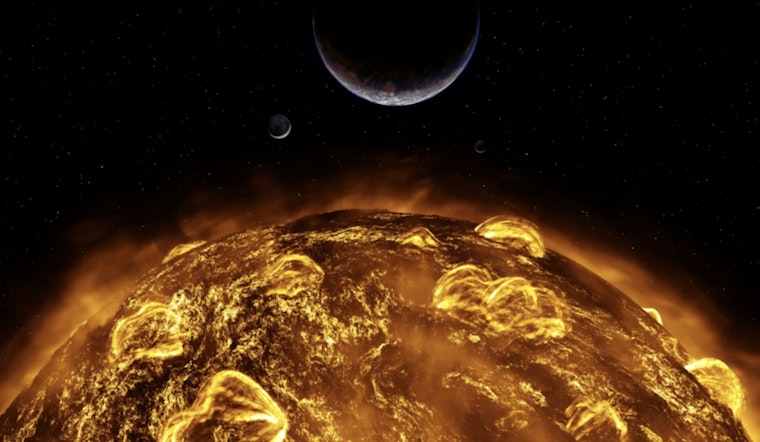
Researchers at the University of Hawaiʻi Institute for Astronomy are using a new AI tool to map the Sun’s magnetic field in 3D. Led by postdoctoral researcher Kai Yang, the study could improve space weather forecasts and protect Earth’s critical systems.
“The sun is the strongest space weather source that can affect everyday life here on Earth, especially now that we rely so much on technology,” Kai Yang told Big Island Now. Yang said mapping the Sun’s magnetic field is difficult because instruments couldn’t tell if the field points toward or away from Earth—similar to seeing a rope from the side without knowing which end is closer. The challenge is worsened by the Sun’s layers: looking at it means seeing several layers at once, making it hard to place magnetic structures accurately.
IfA a researcher, working with the National Solar Observatory and the High Altitude Observatory, developed the Haleakalā Disambiguation Decoder, a machine-learning system based on the principle that magnetic fields form continuous loops. The algorithm can now determine the true direction of the Sun’s magnetic field and estimate the heights of its layers, overcoming previous limitations.
According to the University of Hawaiʻi News, field-testing the AI on various solar phenomena, it performed exceptionally well in calm regions, active zones, and complex sunspots. "With this new machine-learning tool, the Daniel K. Inouye Solar Telescope can help scientists build a more accurate 3D map of the Sun’s magnetic field,” Yang said. Accurate AI analysis is essential for interpreting the telescope’s high-resolution imagery.
This advancement allows scientists to better visualize the Sun’s magnetic field, improving forecasts of solar activity that could disrupt life on Earth. It also provides a clearer understanding of what drives solar eruptions, marking a major step forward in space weather science.




