

























































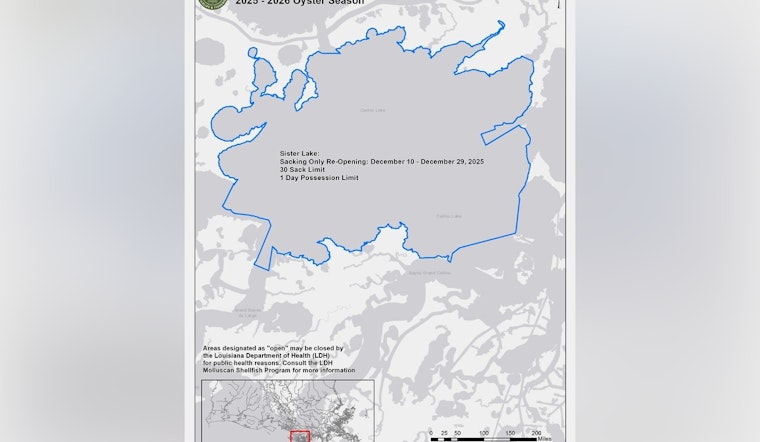
Oyster aficionados and industry workers alike have reason to celebrate as the Louisiana Department of Wildlife and Fisheries (LDWF) announces the reopening of the oyster season in parts of the Public Oyster Seed Reservation in Sister Lake. Starting before the break of dawn on Wednesday, December 10, harvesters will be able to gather market-size oysters, those larger than 3 inches, for sacking – that is, for direct sale.
Monitoring has revealed that Sister Lake still houses a bounty of these bivalves, prompting the decision to reopen. However, there are strict rules in place. Each vessel is restricted to a limit of 30 whole sacks of oysters per day, ensuring that exploitation does not outweigh preservation. Furthermore, according to LDWF's report, all harvests must be reported daily through an eReporting app backed by both iOS and Android platforms. This step not only aids in tracking the harvest but also in managing resources properly.
The closure is set for one-half hour after sunset on Monday, December 29, but the rules are clear: market oysters must be uncontaminated, sealed, and not gaping – a measure that speaks to the quality expected at the time of sale. To be considered for market size, oysters must measure at least 3 inches from hinge to bill, another detail stipulated by regulators and shared through the Louisiana Department of Wildlife and Fisheries.
Oyster harvesting, a key player in Louisiana's economy, is wrapped in regulation aimed at sustainability. For instance, during off hours between sunset and sunrise, all oyster scrapers must be unshackled on active vessels – a rule designed to prevent unauthorized harvest. The Secretary of the Department retains the right to adjust the sack limits and to set or change closure dates, if harvest data or enforcement issues warrant such actions. The LDWF emphasizes the balance between the opportunity for economic gain and the responsibility to maintain ecological integrity.




