

























































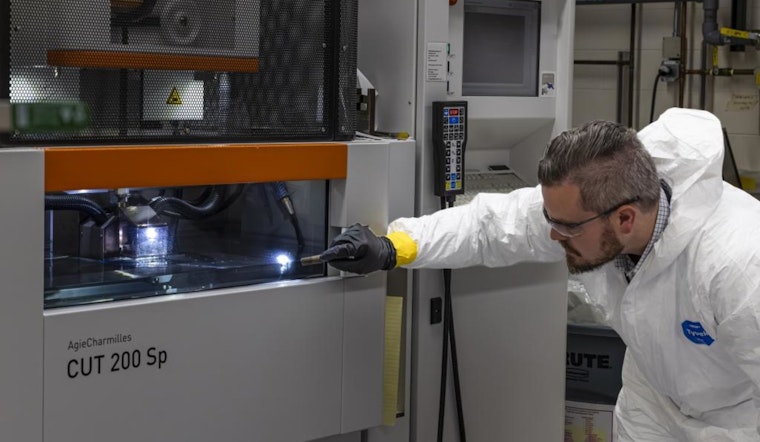
In what's being hailed as a significant milestone for the nuclear sector, Oak Ridge National Laboratory (ORNL) has made strides in utilizing 3D printing technologies to produce nuclear reactor components, offering the promise of safer and more efficient energy generation. As energy demands surge on a global scale, and artificial intelligence demands increasingly larger power sources, researchers at ORNL are pushing the envelope with new metal alloys and materials that could revolutionize reactor design and performance.
The research, as reported by ORNL, acknowledges the challenges associated with testing nuclear materials, which must endure radiation and corrosive environments in reactors. Caleb Massey, a key player in this endeavor, told ORNL that qualifying new nuclear materials "takes time because significant experimentation is required to prove their safety in a multitude of environments," specifying the intense irradiation fields and corrosive environments they will face.
When it comes to 3D printed materials, the process of qualification is markedly different from conventional methods. While traditionally, materials are expected to have uniform properties throughout, produced via consistent processes, 3D printed materials can exhibit variations within a single component, making testing more complex. "So, we design experiments that examine how much variance in properties we might expect within a larger component," Massey explained in the ORNL release. This detailed approach is key to ensuring the reliability of the next generation of nuclear components.
Advanced modeling and the integration of AI are two primary tools that could significantly reduce the time needed for material testing. By carefully calibrating powerful models, researchers can simulate material behavior under stress with a high degree of accuracy, thus reducing the need for extensive physical tests. Moreover, Massey pointed out that AI helps in selecting optimal tests to conduct, "instead of having to perform thousands of high-temperature mechanical tests." This streamlined approach could greatly expedite the material qualification process.
ORNL's research aims at accelerating the qualification of 3D printed materials by tackling processing parameters, developing irradiation campaigns, and working collaboratively with regulatory bodies. The implications of this research could be transformative for the nuclear industry, potentially solving supply chain bottlenecks and enabling nuclear solutions to keep pace with the increasing demands of AI power consumption. The success of this program doesn't just hinge on innovation in research; it's also about the collaboration between national labs like ORNL and other industry partners, a sentiment echoed by the research initiative funded by the U.S. Department of Energy's Advanced Reactor Demonstration Program.





