

























































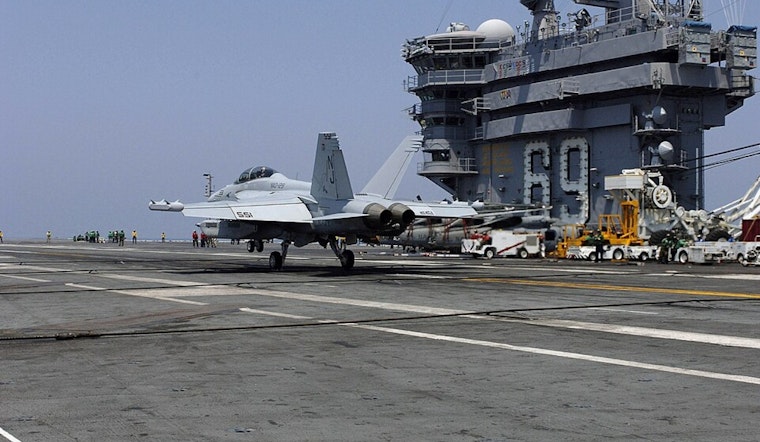
Newly released records show a Navy EA-18G Growler shot upward roughly 8,000 feet with no one in the cockpit after both aviators punched out during a botched landing at Naval Air Station North Island earlier this year. The ghost jet eventually stalled and knifed nose-first into San Diego Bay near Shelter Island, missing homes, hotels and waterfront restaurants by a painfully slim margin. Both crew members were fished from the water and taken to UC San Diego Health in stable condition.
How the mishap unfolded
According to documents obtained through a Freedom of Information Act request, the aircrew had swapped into a spare jet after their original aircraft developed a fuel leak, then joined a tanker to top off before heading back to base. On final approach to North Island, the pilot reported a wet runway, a tailwind and a faster-than-normal landing speed.
He told investigators the brakes felt "mushy." A tower controller radioed that there was "not enough runway," and seconds later the pilot called "EJECT, EJECT, EJECT." Both aviators pulled their handles.
Surveillance video reviewed by investigators shows the now-empty Growler clawing up to about 8,000 feet, then stalling and diving into the bay. Retired accident investigators who looked over the records told reporters the tower warning may have added one more layer of confusion in an already overloaded cockpit, complicating the split-second decision-making in those final moments, as reported by 10News.
Rescue and response
The two aviators parachuted into San Diego Bay and were picked up within minutes by the crew of the sportfishing boat Premier. From there, they were transferred to a U.S. Customs and Border Protection vessel and then taken ashore to UC San Diego Health for evaluation.
The Coast Guard and Navy quickly locked down the crash site while emergency teams deployed containment booms to corral fuel and debris, according to reporting by the Associated Press, as reported by Associated Press.
Salvage and environmental caution
Navy salvage teams then spent weeks combing the Shelter Island basin. Working across a debris field of roughly 13,000 square feet, crews hauled up more than 15 tons of wreckage and ultimately recovered about 85% of the jet, officials said, before heavy cranes and barges were finally pulled out of the harbor.
Throughout the operation, divers and salvage workers coordinated with environmental agencies, clearing the bulk of the debris before scaling back to more limited recovery and monitoring once the biggest pieces were gone. As reported by Times of San Diego and local reporting by The Coronado News.
What investigators found
By October, the Navy had wrapped up its mishap investigation and ruled out mechanical failure. Investigators concluded that human error, combined with lousy weather conditions including a wet runway and a landing with a tailwind, kept the jet from stopping safely.
The report found the pilot should have applied maximum braking techniques but did not, which left the crew with precious few options as they ran out of pavement. Naval Air Forces said leadership has since reemphasized crew resource management, approach discipline and strict adherence to training across the command, as reported by 10News.
Why it matters for neighbors and aircrews
Doorbell and security cameras that caught the final nose-dive made one thing crystal clear: this jet came uncomfortably close to slamming into one of San Diego's busiest waterfront strips. That near-miss has renewed attention on landing safety at North Island, especially during wet and tailwind conditions.
In the weeks after the crash, the Navy urged residents and boaters to steer clear of any stray wreckage and to report debris to Naval Base Coronado instead of hauling it home as a souvenir. Environmental teams monitored the water as salvage progressed, while local outlets chronicled both the recovery work and the neighborhood reaction.
The episode has already prompted commanders to remind flight crews about braking technique, approach planning and strict go-or-no-go decisions in wet or tailwind landings. For neighbors along the bay, it was a stark reminder of how quickly an in-flight emergency can threaten waterfront blocks, and why officials keep repeating the same advice: if any debris washes up, do not touch it. Call base authorities and let them take it from there.



