

























































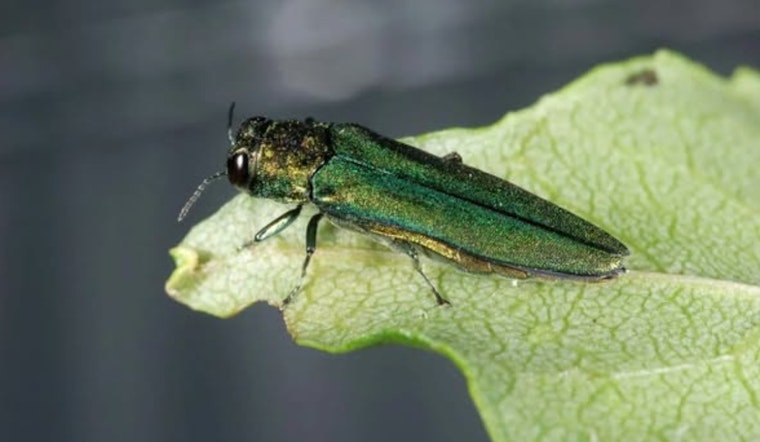
Arlington’s parks crew is sounding the alarm after officials confirmed emerald ash borer in Tarrant County, and they want residents to check their own yards, not just city parks.
In a warning posted Thursday, Arlington Parks & Recreation shared photos of the tiny metallic-green beetle’s damage and urged homeowners to inspect ash trees for trouble, avoid hauling firewood around North Texas and report anything suspicious to the statewide hotline at 1-866-322-4512. Staff reminded residents that ash trees pull their weight in the neighborhood ecosystem, providing shade, wildlife habitat, stormwater benefits and cleaner air. City crews, they said, will be keeping a close eye on park trees while the county coordinates a broader response.
How the beetle kills ash trees
The emerald ash borer does its worst work out of sight. Its larvae tunnel into the tree’s phloem, carving winding S-shaped galleries under the bark that cut off water and nutrients. Once that internal plumbing is disrupted, affected trees decline and can die within a few years.
According to the Texas A&M Forest Service, early infestations can be subtle. Homeowners may see thinning crowns, D-shaped exit holes in the bark, vertical bark splits and new sprouts shooting from the trunk as the tree tries to compensate.
What Arlington is telling residents to look for
In its post, Arlington Parks & Recreation walked residents through the hands-on signs to watch for: D-shaped exit holes in ash bark, splitting bark, leafy shoots popping out of the trunk and dead or dying branches up in the canopy. They also slipped in a firm reminder about firewood: do not move it around if you can help it.
The department is asking neighbors to buy firewood locally, give ash trees in yards and parks a closer look and report any suspicious damage to the statewide hotline at 1-866-322-4512. The guidance and images come from Arlington Parks & Recreation.
Quarantine rules and what they mean
The Texas Department of Agriculture has a quarantine in place on ash material in multiple counties, including Tarrant, in an effort to slow the beetle’s spread by people, not insects. That quarantine restricts how firewood, lumber and other regulated ash materials can be moved out of affected areas.
As outlined by the Texas Department of Agriculture, the rules spell out which counties are covered and what kinds of regulatory treatments or permits are required when ash wood or wood products leave those zones. In practical terms, that bundle of ash firewood is supposed to stay put.
How homeowners can protect valued trees
For homeowners with high-value ash trees, Arlington’s message is not to guess. The city recommends talking with a certified arborist about whether preventative injections or removal make sense. If more than half of a tree’s crown is already dead, removal is usually advised both to reduce safety hazards and to cut down on local beetle habitat.
The Texas A&M Forest Service notes that therapeutic injections of systemic insecticides, such as emamectin benzoate (TREE-äge®), can protect important trees for a period while heavily infested trees nearby are removed to lower local pressure. Residents who suspect emerald ash borer or want to report damage are urged to call the statewide hotline at 1-866-322-4512.
Wider context
Emerald ash borer is now established across much of the United States, and a patchwork of federal and state programs relies on trapping, quarantines and treatments in an effort to slow its march. Federal materials from USDA APHIS highlight the national scale of the outbreak and efforts to monitor and protect young ash trees.
Locally, Arlington Parks & Recreation says it will keep the community updated as it works with county and state partners on next steps. In the meantime, residents who think they are seeing ash borer damage are encouraged to photograph the tree, note the location and either call the statewide hotline or get in touch with a certified arborist. Keeping firewood local and leaving park wood where it lies are simple moves that, collectively, can help slow the spread of this tiny but high-impact pest.





