

























































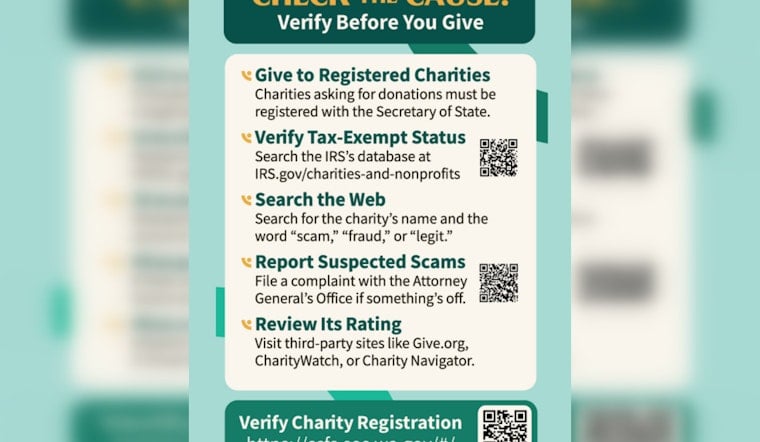
As holiday cheer spreads and higher spirits encourage generosity, Washington State's top legal advisors caution residents to guard their goodwill against charity frauds and scams. The Attorney General's Office (AGO) and the Office of the Secretary of State emphasize the need for vigilance through their "Pause. Check the Cause." campaign, crucial for ensuring that one's charitable contributions actually reach the intended beneficiaries.
With International Charity Fraud Awareness Week underway, transparency remains vital in distinguishing genuine charities from deceitful enterprises. Before pulling out their wallets, donors are urged by the AGO to take a moment, verify the organization's authenticity via tax-exempt status, and ensure it's duly registered with the Secretary of State. According to a statement obtained by atg.wa.gov, Washington Attorney General Nick Brown remarked, "Giving back to the community is vital and strengthens the fabric of our state."
Spoofing or impostor scams, as outlined by the AGO, often see perpetrators adopting names echoing those of established charities, or alternatively, playing a game of names, soliciting multiple donations under different guises. The recommended shield against such deception is thoroughness—request the charity's employer identification number (EIN), run it through official databases like those of the IRS, and always opt for direct donations via verified websites.
Phishing scams lure donors with counterfeit emails or texts, complete with links to fraudulent sites masquerading as legitimate nonprofits. The AGO's advice is simple: circumvent the bait, head straight to the charity's verified website, and keep an ear to the ground for unsolicited requests. Before offering financial support, directly calling the charity shines as a beacon of due diligence.
Pop-up scams and opportunists looking for a quick buck often surge following disasters or during surges of social consciousness, with sham organizations emerging overnight. Savvy donors should turn to registered charities with a history extending beyond three years and approach crowdfunding with a critical eye. In the realm of payment-method scams, one must navigate the terrain with care, favoring security over convenience to keep personal and financial data out of the clutches of scammers, as detailed by the AGO.
During the giving season, and indeed year-round, the AGO's advice is crafted to shield the well-meaning from the harrowing experience of betrayal. By pausing to verify and giving mindfully, Washingtonians can ensure their charity strengthens the state, rather than lining the pockets of fraudsters.





