

























































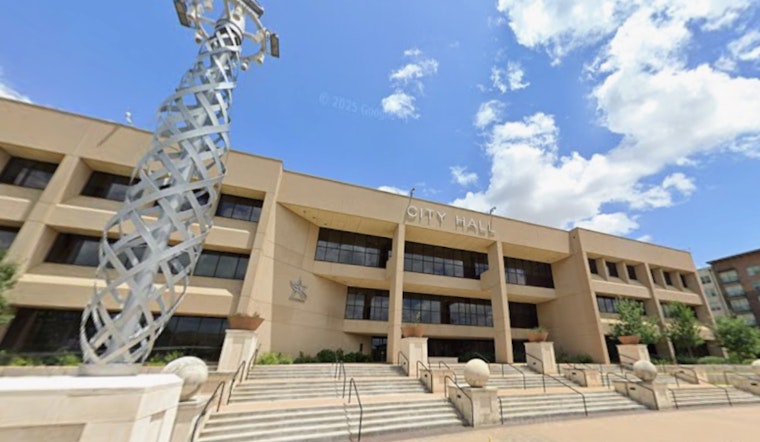
Downtown Arlington’s future skyline got a little clearer this week, as city leaders dug into a draft form-based code that could redraw streets, tighten building frontages and allow a taller core in the heart of downtown.
Consultants walked the City Council through a plan that carves the pilot area into a set of distinct neighborhoods, ranging from a low-rise traditional district to a denser downtown core. The idea is to pair clear design rules with a street network that encourages walkable blocks and faster, more predictable redevelopment.
City staff and outside planners have been working on the code as part of a broader effort to better connect downtown with the Entertainment District and the University of Texas at Arlington. That work included a multi-day design charrette to collect feedback on building types, frontage character and where taller projects should go. Those workshops helped shape the emerging preferences for what belongs where, according to KERA.
What consultants recommended
At the council session, Jayashree Narayana of Livable Plans & Codes laid out a draft that would split the form-based code area into five subdistricts: a traditional neighborhood, an urban neighborhood, corridor mixed-use, a downtown core and a special gateway district. Each comes with its own proposed height range, as reported by Fort Worth Report.
In broad strokes, the downtown core could climb to as high as 12 stories, the urban neighborhood would generally sit around three to five stories, and the traditional neighborhood would stay close to two stories. The structure is meant to create clear transitions from existing lower-scale blocks to a more vertical center without leaving developers guessing what the city wants.
Streets, frontages and who pays
The draft code also includes a regulating plan that sketches out potential new streets and tighter frontage rules that would influence how parcels are laid out and how buildings meet the sidewalk. City materials describe the Regulating Plan as a map that guides where buildings, gathering spaces and streets should go, not a guarantee that the city will pay for every new road or connection, according to the City of Arlington.
Consultants highlighted proposed standards for building frontages, including sidewalk widths, how close buildings sit to the street, where parking can be placed and how storefronts and signage engage pedestrians. The goal is that future projects create a more predictable and consistent public realm. Those kinds of rules sit at the heart of form-based codes, which regulate form and frontage more than specific land uses, the Form-Based Codes Institute explains.
Timeline and next steps
The city’s timeline is relatively brisk. The Planning and Zoning Committee is expected to hold a public hearing on the draft on Wednesday, March 4, 2026, with City Council votes set for April 7 and April 21, according to Fort Worth Report. If council signs off as anticipated, the form-based code would become the primary tool guiding redevelopment in the pilot area.
Councilmembers have spent months debating where that pilot area should start and stop. Some have pushed for a wider boundary that more explicitly links downtown to the stadiums and UTA, while others prefer a tighter footprint that is easier to manage. Earlier coverage shows that public preference can shift from block to block, and that policymakers and planners have been weighing tradeoffs between scale and manageability as they refine the proposal, KERA reported.
What it could mean for builders and neighbors
For developers, the code is pitched as a way to cut down on guesswork by spelling out frontages, build-to lines and allowable massing. For nearby residents and business owners, it promises clearer expectations about height transitions, sidewalk treatments and how new buildings will hit the street.
The consultant team includes planners with long experience in writing codes that try to bridge market realities with walkable urban design. The regulating plan is intended to serve as a steady template as private projects come in, rather than forcing each proposal through a one-off negotiation.
City staff say maps, draft materials and recorded presentations are already posted online, and that residents will have more chances to weigh in before any votes are taken. For the regulating plan, design charrette materials and survey results, the city points people to the Form-Based Code project page at ArlingtonListens.





