

























































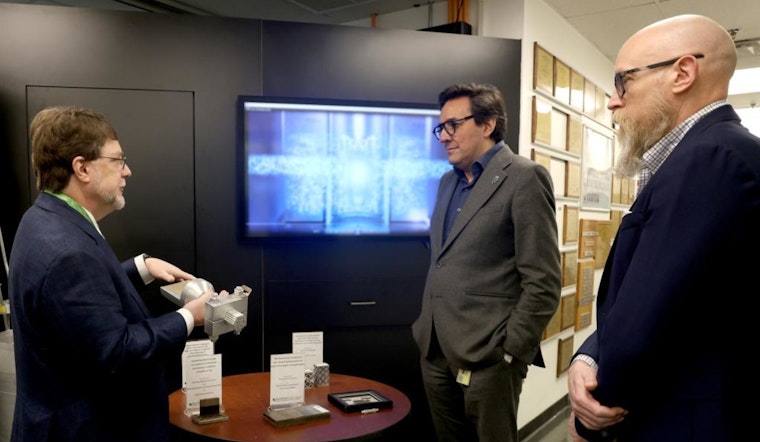
Jon Taylor, a seasoned professional with over two decades of expertise in condensed matter physics, has recently been appointed as Associate Laboratory Director for the Neutron Sciences Directorate (NScD) at Oak Ridge National Laboratory (ORNL), as announced on January 9 by the lab's director, Stephen Streiffer. Taylor's rise to this prominent position within the Department of Energy's facility follows his tenure as the Neutron Scattering Division Director, where he established his credentials at institutions such as the ISIS Neutron and Muon Source in the UK and the European Spallation Source in Sweden.
Tasked with leading ORNL's Spallation Neutron Source and High Flux Isotope Reactor, which are instrumental in neutron scattering research in multiple scientific disciplines, including the physical, chemical, and biological sciences, Taylor's extensive experience will be crucial to overseeing these highly sophisticated and leading-edge facilities; moreover, HFIR is lauded as the highest flux reactor-based neutron source in the United States, and SNS is prized as the world's most potent pulsed accelerator-based neutron source, according to a statement obtained by the Oak Ridge National Laboratory.
The advancements in scientific computing and the emergence of artificial intelligence are central to Taylor's vision for the future of NScD, where he aims to integrate these cutting-edge technologies into research methodologies, reflecting upon his early days in science where his nascent computing skills, such as using FTP, were considered revolutionary—and now, as he noted in an ORNL announcement, "artificial intelligence is such a transformative thing that is emerging and the way we manage data is just as important as anything else."
Since 2022, Taylor joined ORNL's Neutron Sciences Directorate and his ascension to his current role in June 2023 demonstrates a commitment to building upon the organizations’ research capabilities, particularly in the realm of quantum materials, which have evolved since Taylor's PhD days when these materials were known simply as magnetism he and his team now eye the potential scaling of quantum computing from a material standpoint as they work on developing alternative methods for creating quantum computer components, better known as qubits, these two facilities will soon be joined by the Second Target Station, to further cement the United States' position as a global leader in materials science overall, and specifically in quantum materials.
Taylor emphasized the High Flux Isotope Reactor’s role in the DOE Office of Isotope R&D and Production, noting that his own experience with neutron scattering began during his PhD work at France’s Institute Laue–Langevin. “My experience in neutron scattering started with my PhD experiments performed at the Institute Laue–Langevin, which is a reactor-based neutron source in France,” he told ORNL.



