

























































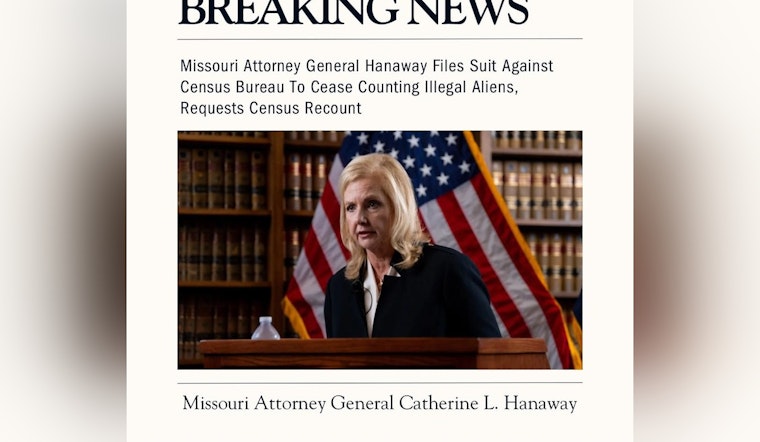
Missouri Attorney General Catherine Hanaway has taken the fight over the 2020 census to federal court, filing a sweeping lawsuit Friday that asks a judge to strip undocumented immigrants and certain temporary visa holders from the population counts used to divide up congressional seats. The complaint argues those headcounts watered down Missouri’s political clout and shifted House seats and federal dollars to states with larger immigrant populations.
The 96-page lawsuit, filed Jan. 30 in the U.S. District Court for the Eastern District of Missouri, names the U.S. Department of Commerce and the Census Bureau as defendants. In a release from the Missouri Attorney General’s Office, Hanaway’s team says the suit contends that counting “illegal aliens and temporary visa holders” for apportionment violated Section 2 of the Fourteenth Amendment and the Administrative Procedure Act. The complaint asks the court to order corrective action for the 2020 apportionment and to bar the Census Bureau from including those groups in 2030.
What the suit asks the court to do
According to the filing, Hanaway wants the court to “require the Census Bureau to redo the 2020 Census and 2021 Apportionment, removing from the apportionment base all illegal aliens and temporary visa holders,” the release from the Missouri Attorney General’s Office says. Her office argues that the current practice shifted an “estimated 11 congressional seats, 11 electoral votes, and billions of dollars” away from states like Missouri. The complaint seeks a court declaration that the current approach is unlawful and an injunction that would change how apportionment is calculated in the future.
Legal scholars say a redo is unlikely
Legal scholars interviewed by local outlets are skeptical that a judge will order anything close to a full census rewind. As KSDK reported, attorneys who have reviewed the complaint say the odds of a court mandating a do-over are near zero. Washington University law professor Travis Crum told St. Louis Public Radio that courts have long read the Fourteenth Amendment’s reference to the “whole number of persons” as covering everyone domiciled in a state, a reading that has guided judges in past census fights.
Why this matters
Census data decide how all 435 U.S. House seats are carved up, and they also help determine how hundreds of federal programs send money to states, counties and cities. The Census Bureau delivered the 2020 apportionment numbers to the president on April 26, 2021, and those figures were then used to redraw political maps across the country, according to the Census Bureau. Media coverage and court records peg the 2020 count at roughly a $14 billion undertaking, a price tag that highlights how disruptive and expensive any court-ordered redo would be, according to reporting republished from NPR.
Legal hurdles and next steps
Because the lawsuit targets congressional apportionment itself, it is expected to trigger a three-judge district court under federal law, a process laid out in 28 U.S.C. § 2284. Even if the case moves forward, legal experts note that decades of practice and precedent supporting a headcount of all residents, regardless of citizenship, make the sweeping remedies Hanaway seeks a very steep climb. For now, the filing adds another high-profile chapter to the ongoing national fight over who gets counted, and who gets the political power and dollars that flow from those numbers.


