

























































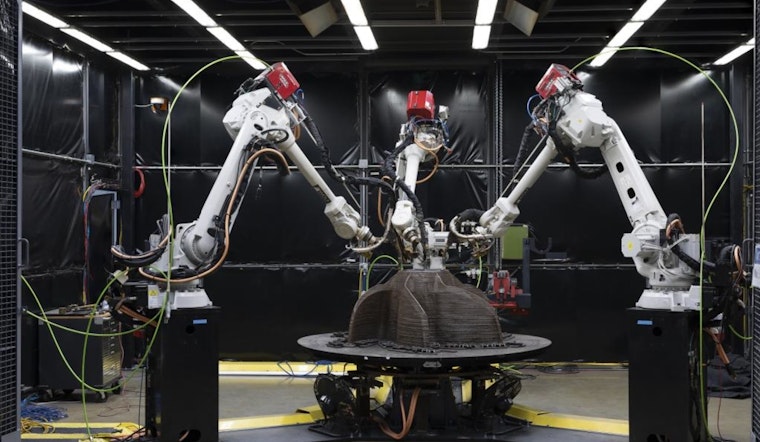
In a move that's shaping up to be a game changer for American metal manufacturing, the Oak Ridge National Laboratory's Manufacturing Demonstration Facility (MDF) has teamed up with Ohio's Lincoln Electric to innovate large-scale metal 3D printing. This partnership, according to a release from ORNL, is cutting the cord on overseas reliance for metal parts production, an issue plaguing industries from energy to defense.
With decades of experience under their belts, Lincoln Electric is adding their advanced welding tech into the mix, crafting solutions previously bogged down by import delays. "Months- or year-long lead times for forged or cast components from overseas limit how quickly companies can innovate and fabricate," explained Bill Peter, advanced manufacturing program director at ORNL, as per the ORNL report. Together, they've developed the wire arc additive manufacturing (WAAM) system using a robotic arm that spits out metal layers to construct complex shapes and multi-material depositions.
The WAAM technology is not just another printer in the lab; it symbolizes domestic self-reliance and innovation. One of its most public demonstrations, as recounted by ORNL, was an excavator arm printed for a 2017 trade show. "We worked as true partners. Both teams’ contributions were vital for proving out the new technology,” Jason Flamm, Lincoln Electric Additive Solutions general manager, expressed in the report. Their work goes beyond just a tech demo; it's about rethinking manufacturing software to fully engage robotic capabilities—a shared venture that has the potential to reshape the large-scale 3D printing landscape.
What's next for this collaboration? An ambitious robotic system named MedUSA that uses three robotic arms to conjure up huge metal parts. While the MDF team wrangled multiple bots to work in harmony without mishaps, they nailed down a deposition rate of 100 pounds of material per hour—pushing boundaries in speed and size for the manufacturing sector. In 2024, ORNL noted that MedUSA even clinched an R&D 100 Award, solidifying its place in technological advancements. "We’ll keep going bigger and faster," Joshua Vaughan, group leader for Manufacturing Robotics and Controls at ORNL, stated in the ORNL article.
On the commercial front, Lincoln Electric is not resting on their laurels. They have formed Lincoln Electric Additive Solutions, catering to various industries with metal 3D printing services. Even the U.S. Navy and the U.S. Army Corps of Engineers tapped into this tech for hefty components and speedy repairs, such as a hefty ship arrestor arm that was created in a fraction of traditional manufacturing time, as per the ORNL statement. "We’ve had a lot of success," said Mark Douglass, business development manager for Lincoln Electric Additive Solutions in the article, hinting at a future where digital parts qualification could further revolutionize how we think about manufacturing.



