

























































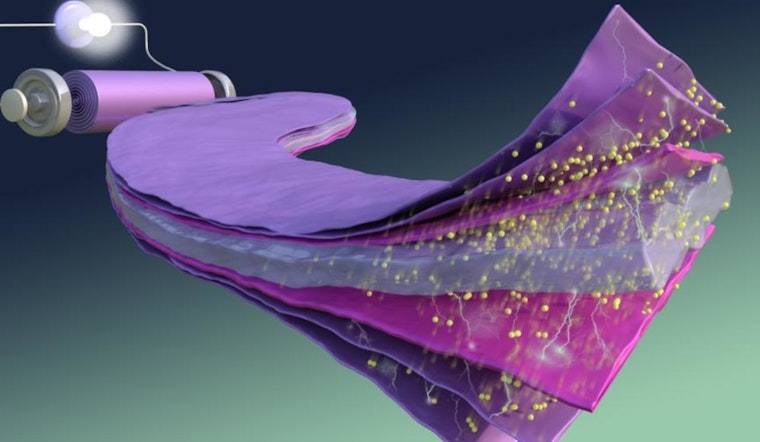
In what's shaping up to be a significant boost for the energy storage sector, Oak Ridge National Laboratory researchers are introducing a safer, more enduring alternative to contemporary systems. According to information from a study published in Advanced Functional Materials, the team at ORNL has crafted a new energy storage design using ionogels, a state-of-the-art material that could potentially improve energy storage safety and efficiency across multiple industries, including consumer electronics and aerospace.
The ORNL study, bolstered by collaboration with the University of Tennessee, Knoxville, and the UT-Oak Ridge Innovation Institute, has made headway with what they call pseudosolid polyelectrolyte membranes. While navigating towards higher safety and efficiency in energy storage, researchers have layered ionogels between pliant ultrathin polymer sheets, which has effectively combined conductivity with structural strength. Bishnu Prasad Thapaliya, the principal investigator from ORNL's Chemical Sciences Division, touted this balance as an upgrade to both efficiency and safety.
Typically, energy storage systems use flammable liquid electrolytes, which present risks, such as fires from short circuits. The new design presented by ORNL aims to eliminate these vulnerabilities by removing the need for traditional liquid electrolytes. Researchers developed a system that uses lithium salts and nonflammable ionic liquids to create a membrane robust enough to prevent lithium dendrites, which are spike-like structures that compromise system integrity and safety. "This balance upgrades both efficiency and safety," Thapaliya told ORNL's newsroom.
Dendrite formation, a notorious problem when using lithium in energy storage, can lead to dangerous short circuits and consequent fires. Thapaliya and his team, in their creation, have incorporated a layered design that bolsters mechanical strength, allowing their membranes to withstand internal pressures and inhibit dendrite punctures. The result marries the mechanical strength of solids with the ion-flow efficiency of liquids, promising stable, efficient performance over hundreds of charge/discharge cycles. Thapaliya and his team hope that with the support of the Autonomous Chemistry Lab, even overnight, robots could eventually automate the gel assembly.
Looking ahead, the ORNL research, supported by DOE's Office of Science and the National Science Foundation, isn't merely an exercise in academic ingenuity. "Our goal is to build on this research and make a scalable membrane that can also be used in commercial energy storage systems," Thapaliya commented in an interview with ORNL. To that end, researchers plan to continue developing these membranes for potential installation into prototype devices, hopefully charting a course towards safer, more reliable energy storage on a scale ready for the consumer market.





