

























































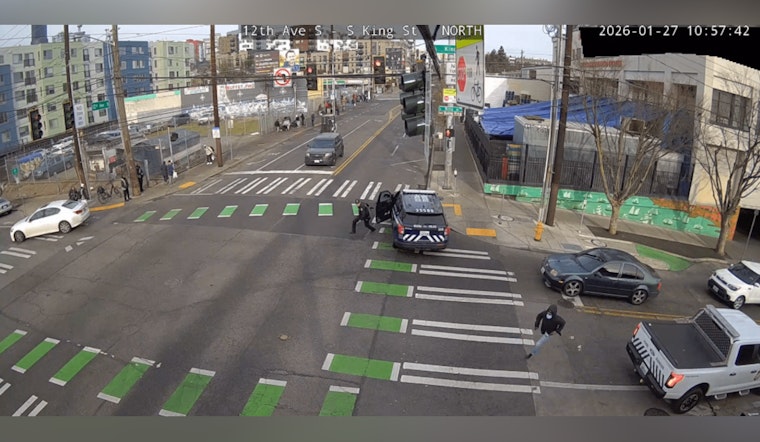
A short video released yesterday by the Seattle Police Department shows a man the department describes as a felon quickly tossing small packages and cash onto a sidewalk while a live camera records. The clip appears to show the man discarding suspected narcotics before walking away, a raw snippet of what SPD is calling suspected drug activity. In the post, the department labeled the information as preliminary and did not identify the man. Even so, the footage has already stirred fresh debate over Seattle’s expanding live-camera program and how those feeds should be used.
Seattle police push the clip on X
Seattle police posted the brief video on their official X account, describing the person in the frame as a felon seen “tossing drugs and cash.” The department added its standard disclaimer that the information is preliminary and could change as the case develops. In the clip shared by the Seattle Police Department, the man drops several small items near a curb, appears to scatter some bills, and then walks away as the camera keeps rolling.
Captured by the Real Time Crime Center
The video lines up with the department’s growing use of its Real Time Crime Center, a centralized hub that officials say pulls in CCTV, traffic-camera feeds, and other data to give analysts and dispatchers a live look at what is happening on city streets. City leaders and SPD argue that the RTCC helps officers find suspects and preserve evidence faster than traditional approaches. As outlined by the Mayor's Office, the center has been credited with assisting in hundreds of incidents and investigations since it came online.
Privacy and civil-liberties concerns
The same expansion of live feeds into the RTCC has drawn steady criticism from privacy advocates and some city council members, who warn about how long data is kept, who gets monitored most, and how the footage might be misused. Opponents argue that safeguards need to be stronger if the program is going to push into more neighborhoods and pull in additional municipal feeds such as traffic cameras. Coverage of the ongoing debate notes that the city recently moved to widen where cameras can be deployed, raising familiar questions about how to balance public-safety claims with civil-liberties protections, as reported by GovTech.
Local watchdogs keep pressing for oversight
Neighborhood advocates and local watchdog outlets have continued to call for greater transparency and independent audits of how RTCC data is accessed, shared, and stored. Critics point to racial-equity analyses and public comment that flagged possible harms from a wider surveillance footprint, arguing that those warnings have not been fully addressed. Those tensions have been documented as the city weighs how far to extend the program, according to reporting by The Urbanist.
How the clip fits into recent enforcement efforts
Police leaders have repeatedly highlighted RTCC footage when defending the system, saying analysts can quickly push images and movement details to officers in the field. Early reporting on the center’s operations found that the RTCC supported hundreds of incidents soon after it opened, a talking point SPD uses to argue that the system strengthens investigations. As reported by Police1, officials have described the center as a force multiplier for patrol units.
In the latest post, the department did not identify the man in the video or say whether officers later contacted or arrested him, and SPD offered no additional case details beyond what appeared in the clip. The footage shared by the Seattle Police Department was explicitly labeled as preliminary information and could be updated if investigators recover the discarded items or locate the suspect. If that happens, the short video is likely to become a key piece of any follow-up investigation.





