

























































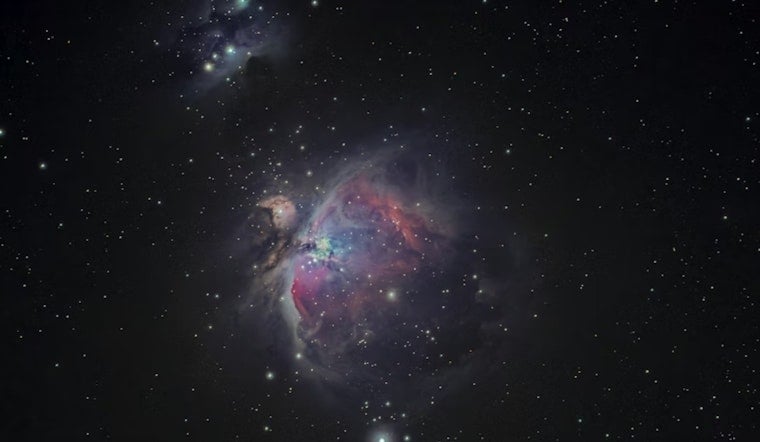
In a notable collaboration stretching across seven countries and comprising over 400 scientists, the Dark Energy Survey has taken strides in mapping the night sky with unprecedented detail. The project, driven by the U.S. Department of Energy's Fermi National Accelerator Laboratory, aims to decipher the elusive nature of dark energy—an enigmatic force believed to drive the accelerating expansion of our universe.
Central to this international effort stands University of Cincinnati physicist Jessica Muir. According to a recent report by UC News, Muir has played a pivotal role in data analysis for the project, which observed the cosmos from the high altitudes of the Andes Mountains in Chile. The Dark Energy Survey, conducted between 2013 and 2019, took advantage of 758 nights of observation, meticulously cataloguing hundreds of millions of galaxies to measure the distribution of matter with high precision.
The initiative has heightened our understanding of cosmic structures and their evolution, as outlined by Muir: "Galaxies form in regions where there's a lot of matter, so studying how galaxies cluster and how their light is distorted by gravitational lensing tells us about how structures grow over the history of the universe," according to UC News. The data, including the way light from distant galaxies is warped by gravitational clusters, has challenged physicists to look beyond the concepts underpinning general relativity.
With her background in applied mathematics and physics, documented by a master’s degree from Cambridge University and a doctoral degree in her field, Muir has been instrumental in developing statistical techniques for the survey. "We use statistics to test our understanding of the universe," she told UC News. This has involved leading efforts to check the consistency of different parts of the data, crucial in validating whether the cosmological constant—postulated as the simplest model for dark energy—stands as a constant or varies with the universe's expansion.



