

























































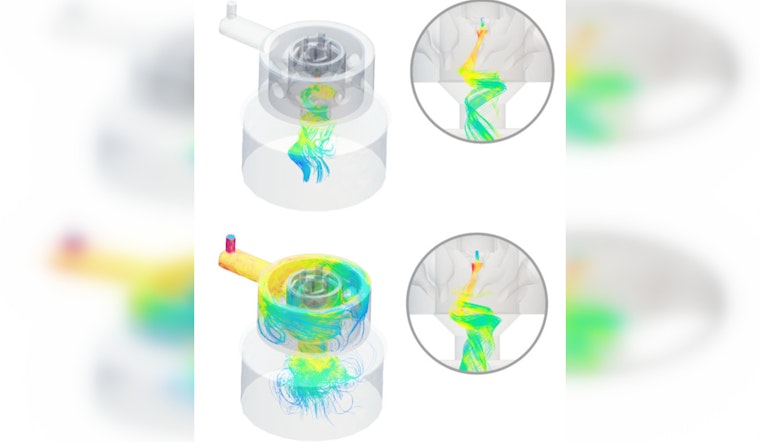
Researchers at the University of Maine and the U.S. Department of Energy's Oak Ridge National Laboratory have teamed up to advance the production of cellulose nanofibers, a potential replacement for plastics in numerous products. Their new drying technique rapidly dehydrates wet cellulose slurry mixtures using counter-rotating vortices of heated compressed air, described as "mini tornadoes," which proves to be more energy-efficient and scalable than previous methods.
The significance of cellulose nanofibers lies in their ubiquity and strength; they are bio-based materials derived from plants that could enhance the durability of concrete, create bone replacements, and provide biodegradable packaging solutions. However, the challenge has traditionally been in the drying process to avoid fiber aggregation. Attempting to dry the gel-like slurry—a grind down of wood pulp mixed with water—is not only costly due to its high water content, but it also risks producing clumps of fibers that are difficult to separate without repeating the pulping process.
According to a report by ORNL, David J. Neivandt, a professor of chemical and biomedical engineering at the University of Maine, with his graduate students, have developed a patent-pending process that challenges these drawbacks. Their approach, which began as a hypothesis in 2018, uses shear forces imparted by twin counter-rotating air vortices to limit fiber aggregation effectively and can be scaled up for commercial production.
Investigations into the fluid dynamics behind this novel process were carried out by ORNL's Manufacturing Demonstration Facility, with findings revealing that air rushing into the vortex generators at speeds of Mach 3 can to tear apart slurry droplets to prevent clumping. "You have a trunk that's smaller than the diameter of a hair, but then the ends continue to split until you have fuzzy ends that are nano-size," Peter Wang, a research staff scientist in ORNL’s Manufacturing Science Division, told ORNL News. On the computational front, Kevin Doetsch, a research scientist in ORNL’s Computational Sciences and Engineering Division, completed complex simulations using a high-performance computing cluster to confirm the efficacy of the method.
This collaborative effort is part of SM2ART Program, managed by the ORNL and UMaine's Advanced Structures and Composite Center, funded by DOE's Advanced Materials and Manufacturing Technologies Office. The overarching goal is to meet the burgeoning demand for cellulose nanofiber across various industries such as packaging, construction, and automotive. The research endeavors are validated by economic analysis, which is instrumental for the construction of a large-scale cellulose nanofiber production facility. Neivandt praised the partnership with ORNL, stating, "The collaboration between my research group and the team at ORNL has proven to be incredibly powerful," enabling the swift transition of academic research into industrial application by blending specialized skillsets.
With the environmental impacts of plastics being a global concern, this development in cellulose nanofiber production signals a significant step forward in providing industries with a less energy-intensive and naturally-derived alternative. It also showcases the combined strength of cross-disciplinary collaborative research in pushing the boundaries of sustainable materials science.



