

























































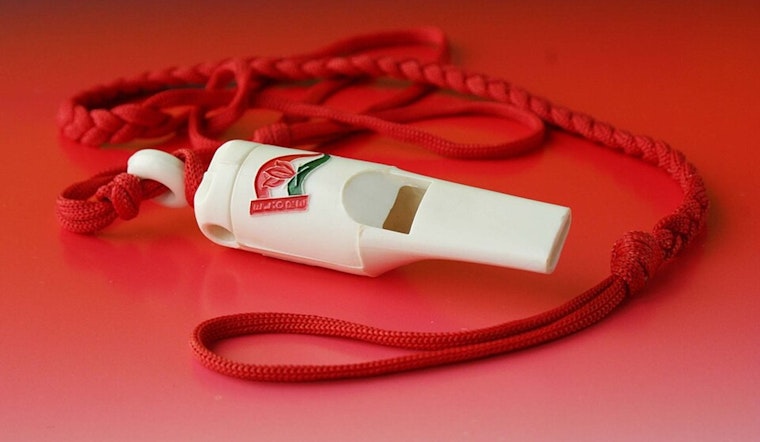
Chicago volunteers say they have now shipped more than 150,000 whistles, instructional zines, and know-your-rights cards to communities where federal immigration agents have carried out operations. What started as a handful of neighborhood “whistle parties” has turned into a loose, fast-growing mutual-aid network that organizers say is sending kits across the country. For many participants, the bright plastic noisemakers are a deliberately low-tech alarm system, meant to warn neighbors, summon witnesses, and draw attention when agents show up.
According to the Chicago Sun-Times, volunteers Emily Hilleren and Lauren Vega recently loaded a hatchback with 5,000 whistles, 10,000 know-your-rights cards, and roughly $9,000 in donated cash, then drove the haul to a Columbia Heights assembly in Minneapolis. The Chicago Sun-Times also reports that, combined with work from groups tied to Pilsen Arts & Community House, the wider effort has pushed more than 150,000 whistles to cities including New York, Baltimore, and New Orleans, along with smaller towns across multiple states.
How Whistlemania Spreads
Locally, neighbors host “Whistlemania” parties at cafes and community spaces, where volunteers fold zines, pack whistles, and bundle kits bound for businesses, little free libraries, and mutual-aid tables. Organizers say the model was adapted from tactics used in Los Angeles and that those early Chicago events drew hundreds of people, making it possible to scale up bulk distribution quickly.
As documented by LA Public Press, similar pack-and-drop gatherings in Los Angeles produced more than 120,000 whistles during the initial wave of activity there, showing how assembly-line style sessions can turn a handful of volunteers into a citywide supply chain.
3D Printers Ramp Up Supply
Once retail suppliers started selling out, volunteers turned to hobbyist 3D printers to keep the whistle pipeline flowing. One maker told the Chicago Sun-Times that a single roll of filament can crank out roughly 800 whistles, cutting the cost per unit. “In five days I produced more whistles,” they said, describing how home setups suddenly became mini-factories.
That homegrown manufacturing, the Chicago Sun-Times reported, let small teams fill email orders and get kits in the mail faster than online retailers could restock, using a simple bit of cost math to justify churning out thousands of plastic alarms.
Where the Kits Have Gone
Organizers say shipments now reach both major metro areas and smaller communities, as local groups copy the whistle-kit template to build their own rapid-response networks. Early adopters in St. Louis, Minneapolis, Denver and Atlanta have staged their own packing events after watching the Chicago and Los Angeles playbooks, showing how a simple design and a shared set of materials can be cloned almost overnight.
LA Public Press noted that groups traded templates, ACLU know-your-rights cards and zine PDFs so that whistle codes and legal information match from city to city, keeping the system recognizable and consistent for people who might move or have family in multiple regions.
Organizers, Safety and the Zine
Volunteer leaders say the zine, created and circulated by local arts groups, spells out a simple whistle code: short bursts to signal that agents are in the area and a sustained blast to mark an active detention, plus guidance on documenting what happens and steps to help protect neighbors. The emphasis, they stress, is on nonconfrontational tactics like warning, recording and rapid legal support rather than physically confronting agents.
WBEZ reported on the zine’s instructions and how Pilsen Arts & Community House helped get those materials into wide circulation, so that people picking up whistles are not just grabbing noisemakers but also basic legal information.
Legal Risks and Community Response
Organizers also acknowledge a tricky legal landscape. While the whistles are meant for warning and documentation, some people who have directly confronted federal agents have faced potential criminal or civil exposure, and groups are tracking both active cases and legal threats. At the same time, the broader whistle campaign has coincided with lawsuits and demands for federal oversight after aggressive enforcement tactics drew scrutiny from city officials and civil-rights advocates.
The Guardian and other outlets have detailed both the rapid spread of these mutual-aid responses and the mounting legal questions communities now have to navigate as they try to warn one another while staying within the bounds of the law.



