

























































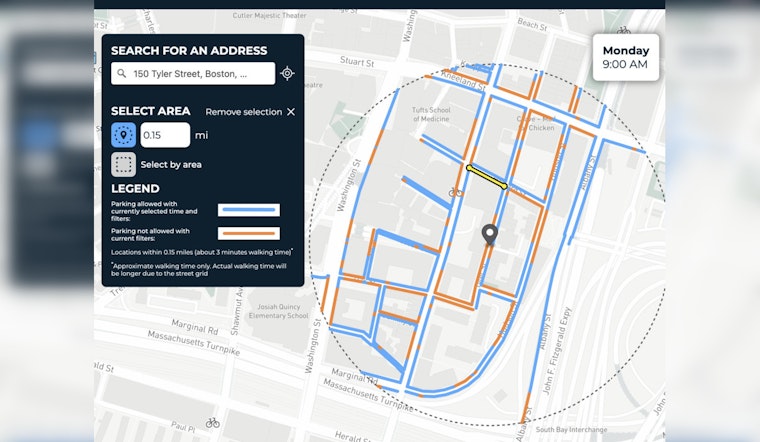
In the bustling streets of Boston, the curb is no longer just a piece of concrete but a battleground for space as the city grapples with the needs of bicyclists, delivery trucks, and outdoor diners, among others. Seeking to navigate this urban challenge, Boston’s Office of Emerging Technology unveiled the Boston Curb Lab, a project aiming to digitize parking regulations and create tools aiding residents with parking navigation.
The Boston Curb Lab's ambitious project has already gained national attention, being named Apolitical’s ‘50 States, 50 Breakthroughs’ honoree for the State of Massachusetts in commendation for its innovative approach to improving citizen public services, integrating artificial intelligence with modern data tools and it's serving as a model for urban planning and transportation. "Every delivery truck circling for a loading zone adds congestion and emissions. Every unclear sign and process creates unnecessary confusion and safety risks," Michael Lawrence Evans, Director of the Office of Emerging Technology, expressed his concerns to the Boston government.
Indeed, the Curb Lab is not just about updating street signs but is a dynamic platform powered by data and AI that transforms centuries-old parking rules into a comprehensive city map of parking regulations; this platform is designed to provide residents with reliable parking information at their fingertips. Synchronizing with long-term city projects like Go Boston 2030 and Vision Zero, the move signifies a leap toward modernizing city functions and redefining how cities can use technology to interact with citizens.
Partnerships are the cornerstone of the Curb Lab, with the Streets Cabinet, Innovation and Technology Cabinet, Office of the Parking Clerk, Office of New Mobility, and Citywide Analytics team collaborating to utilize this digital inventory. The Curb Lab is producing open-source tools that will help manage curb data, sharing it with the public and setting a new standard for cities that's both impactful and replicable in managing curb spaces. Amelia Capone, Director of Parking and Curbside Management, told the Boston government, "For over 40 years, our curb data has lived in disconnected systems that didn’t talk to each other," and "Through the Curb Lab’s leadership, we're finally able to link these systems together. That means less duplication of work, faster response times to constituent requests, and better internal coordination that will directly improve traffic flow and safety on our streets."
Openly sharing this progress, Boston's Curb Lab encourages other cities to adopt similar methodologies without reinventing the wheel. The lab's usage of the Curb Data Specification, championed by the Open Mobility Foundation, ushers in widespread accessibility that could herald a shift in how cities nationwide manage complex curb demands. "Boston is setting the standard for how cities manage curb space in the 21st century," Andrew Glass Hastings, Executive Director of the Open Mobility Foundation, celebrated Boston’s pioneering efforts in a statement released by the City of Boston. The Curb Lab’s updates and open-source code releases are eagerly awaited, with details soon to appear on the official website.





