

























































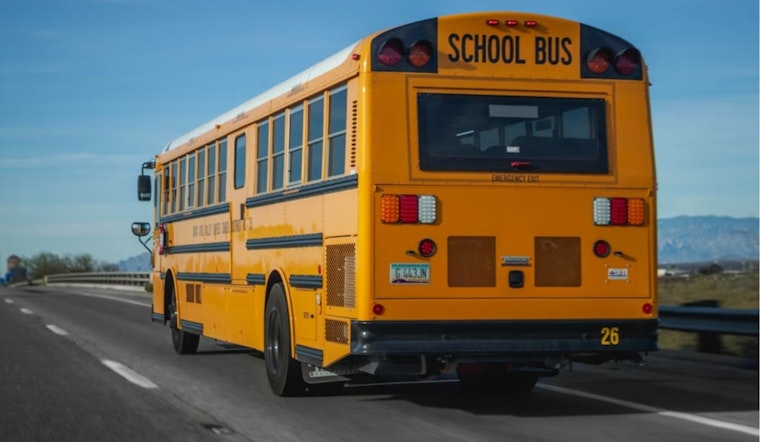
Blow past a stopped school bus in Dearborn now and it might not be a crossing guard who catches you, but a camera and an algorithm. The city has started mailing $250 citations to drivers nabbed by AI-powered stop-arm cameras for illegally passing school buses. Formal ticketing kicked in on Jan. 19, after a warning and public-awareness period that began in mid-December, and the district-wide rollout covers more than 100 buses in what officials are calling Michigan’s first program of its kind.
How the cameras work
Each bus is being outfitted with exterior stop-arm cameras that switch on when the stop arm swings out and the red lights start flashing. The system records video and grabs license plate images, then bundles everything for review. According to the City of Dearborn, safety tech company BusPatrol is providing the hardware and software at no cost to the school district. The company’s AI scans the footage to flag potential violators, and the Dearborn Police Department makes the final call after watching the clips.
Fines, enforcement and the law
Drivers who illegally pass a stopped school bus face a $250 civil infraction for a first offense and $500 for repeat violations within one year, according to MLive. Michigan law requires motorists to stop at least 20 feet from a bus when its red lights are flashing and the stop arm is deployed. The state vehicle code classifies unlawful passing as a civil infraction and authorizes fine ranges for offenders, per the Michigan Legislature.
The scale of the problem
Local officials say these cameras are not a solution in search of a problem. The National Association of State Directors of Pupil Transportation Services estimates tens of thousands of illegal school bus passings occur nationwide on a single day, adding up to roughly 39 million incidents over a full school year. That volume of risky behavior is exactly why advocates argue for automated enforcement paired with driver education, according to NASDPTS.
Early results in Dearborn
During the first days of partial installation, about 25 Dearborn school buses were equipped with the new camera systems, and roughly 30 tickets were issued in the program’s first week, MLive reports. City leaders are highlighting what they call a violator-funded model, and say installation and ongoing operations are covered by citation revenue so that neither the city nor the school district pays out of pocket. For more background on how officials rolled this out and framed it as a pedestrian safety effort, see the AI bus rollout details.
What motorists should know
BusPatrol’s detection engine, often referred to as “Ava,” can analyze traffic across multiple lanes and pull together an evidence package that is forwarded to law enforcement for human review, according to BusPatrol. Drivers who receive a notice in the mail are typically given a secure link to watch the video of the alleged violation along with instructions on how to contest the civil infraction. Local officials and commentators stress that the stated primary goal is to change dangerous driving habits around school buses, not to turn the cameras into a cash machine, as noted by WCSX.
Legal note
The stop-arm citations are civil infractions under Michigan law and can be challenged in court. The Michigan Vehicle Code lays out the penalties and the framework that allows this type of camera-based enforcement, according to the Michigan Legislature. Dearborn officials say every potential violation is reviewed by the Dearborn Police Department before a citation is mailed, something city leaders present as a safeguard intended to cut down on errors and protect motorists’ rights, per the City of Dearborn.





