

























































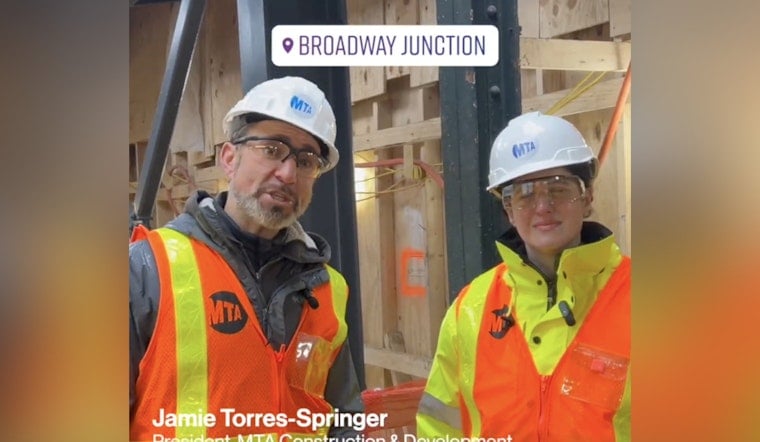
Broadway Junction finally looks like the massive overhaul Brooklyn has been promised. Over the weekend, crews swung towering elevator frames over Fulton Street and into place at the sprawling transit hub, a highly visible step in the long-running push to make the busy transfer point fully accessible. The new lifts, hard to miss for commuters and neighbors, are the first big public signs of the MTA’s plan to add elevators and untangle circulation across the multi-level maze. If all goes as planned, riders on the A, C, J, Z and L lines will eventually get a stair-free route that generations of transit users have gone without, and local officials say the work could reshape both the station and the streets around it.
According to MTA Newsroom, crews lifted the steel frames from street level up to the elevated platforms this week, and the heavy operation did not interrupt weekend subway service. The agency’s post steered riders to its regular "This Week in Construction" project updates on the MTA site for details on upcoming work. Photos from the scene showed cranes and harnessed crews carefully lowering the metal elevator cages into position above active tracks, while trains continued to roll underneath.
What the project includes
The MTA describes Broadway Junction as Brooklyn’s third largest station, a layered complex serving the A and C lines, the J and Z lines, and the L line. The current overhaul is designed to stitch all of that together with a continuous stair-free path. The plan calls for seven new elevators and the replacement of multiple escalators, plus a new street entrance that will feed riders directly to the L train platform, according to the MTA and the NYC Mayor's Office. The work also includes platform repairs, widened staircases and updated signage, all aimed at making transfers between lines less of an obstacle course.
Funding and timeline
City and transit officials have bundled roughly $500 million in combined public realm and transit spending for the Broadway Junction area, with about $400 million set aside for the MTA’s station work, according to CBS New York. Agency statements and local reporting put the major accessibility pieces on a multi-year schedule, with heavy construction expected to run through 2027. The New York City Economic Development Corporation has said its own street-level projects around Van Sinderen Avenue and Fulton Street, including new plazas, lighting and pedestrian safety upgrades, are meant to dovetail with the transit improvements, and that streetscape work is expected to follow the bulk of the station construction.
Community reaction and equity concerns
Neighbors and transit advocates have largely cheered the long-awaited accessibility push, while also warning that big public investments can pave the way for displacement. Local leaders told amNewYork the complex has been "blighted" for years and argued that the station fix should be paired with good jobs, affordable housing and protections for small businesses. City officials, for their part, have pointed to workforce programs and minority and women owned business contracting goals that are supposed to steer more of the benefits toward East New York residents.
What riders should expect
The MTA says it will time heavy lifts and elevator shaft work to limit full station closures, and this week’s frame installation is the kind of move the agency is holding up as proof that big pieces can be put in place without shutting down weekend service. Riders who want detailed construction notices and service change alerts can sign up for the authority’s emails through the MTA website and check posted advisories at station entrances. In the meantime, transit users should brace for the usual side effects of a major rebuild, including occasional lane restrictions near the station, temporary work zones on platforms and planned escalator outages as crews carve elevator shafts and reconfigure mezzanines over the coming seasons.





