

























































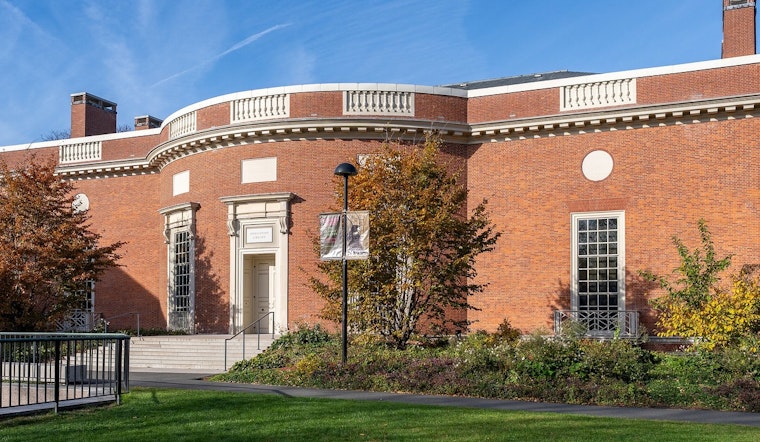
Harvard's Houghton Library is currently hosting an exhibit that probes the enigmatic and often overlooked world of women's contributions to literary history through the medium of typing. Dubbed "Thanks for Typing: Women’s Type Labor in Literature and the Arts," the exhibition, which Harvard is running through May 1, showcases an assortment of items that reveal the depth and variety of this labor. According to The Boston Globe, visitors can expect to find an eclectic mix from T.S. Eliot’s “The Waste Land” typescripts to instructional guides and vintage typewriter ads.
With a fascinating juxtaposition of social history and literary evolution, one can't help but marvel at how, up until the mid-20th century, typewriters helped revolutionize the role of women in the workplace. Shifting from a meager 4 percent presence in clerical jobs in 1880, women held half of these positions by 1920, a surge credited to the typewriter's advent. A pink Olympia manual typewriter is available for attendees to try their hand at typing, offering a tactile connection to an era when Remington and Underwood were household names. Icons like Truman Capote and Vladimir Nabokov are also part of the narrative; the former's disparaging comment, "That’s not writing, that’s typing," featured in a section that delves into how typists influenced literature, as reported by The Boston Globe.
The exhibition is co-curated by Christine Jacobson and Dale Stinchcomb who aimed to cast a spotlight on the typists' indispensable role, historically seen as mere conduits for the words of others. Harvard Library's own website notes, "From the poems of Emily Dickinson to Vladimir Nabokov’s Lolita, many of the masterworks of modern literature were originally written by hand, then typed." The hands responsible for transferring these words from manuscript to typescript were mostly women, whose identities and contributions frequently went unnoticed and uncredited.
The curatorial team has also organized a series of events to deepen the engagement with the exhibit's themes. "The Lady and the Typewriter Film Series" will be hosted at the Harvard Film Archive, featuring films like "His Girl Friday" and "The Hudsucker Proxy," where speedy typing is as central to the plot as fast-talking dames. Hoping to bring historical context to the surface, "Thanks for Typing" presents a broadened perspective on the mythos surrounding the typewriter and those who operated it. Furthermore, as cited on Harvard Library's website, Curatorial Chats accompanied by Christine Jacobson and Dale Stinchcomb offer visitors a chance to delve deeper during guided tours.
Paying homage to typists like Véra Nabokov and Mabel Loomis Todd, the exhibition underlines the often invisible labor of women that undergirded some of the most significant literary outputs. Guests of "Thanks for Typing" are privy to not just a visual but an interactive voyage into a facet of literary production that is too significant to be left unsung. From custom adaptations of typewriters to the untold stories of typing pools at places like 10 Downing Street, the exhibit holds up a mirror to a past ripe with unrecognized potential and latent credit long overdue.





.jpg)