

























































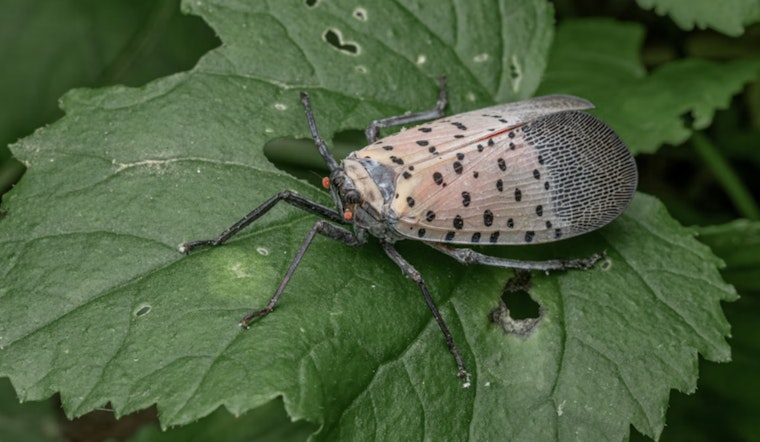
The spotted lanternfly is no longer just someone else’s problem. State agriculture officials say breeding populations of the invasive pest have now turned up in Davidson, Rowan and Caswell counties, pushing the number of North Carolina counties with established infestations to seven.
The latest clusters sit along the I-85 and I-285 corridors and reach as far south as Salisbury. Survey and response teams are already on the ground at the newly identified sites, mapping where the bugs have taken hold and lining up treatments.
In a Feb. 10 press release, the N.C. Department of Agriculture and Consumer Services said the detections followed expanded surveillance, and that survey and treatment work is ongoing, with priority going to spots that are most likely to spread the pest. Licensed NCDA&CS operators handle treatments from April through October, and the agency is urging the public to report anything suspicious.
“Spotted lanternflies like to feed high in the treetops, but they are not good at telling the difference between a truck tire and a tree trunk,” Amy Michael, entomological programs manager, said in the release.
Where the populations were found
State officials describe breeding populations along I-85 and I-285 through Davidson County, with confirmed detections in Rowan County as far south as Salisbury. Local public radio coverage from WFAE reported that separate infested areas were also identified near Pelham in Caswell County, a stretch connected by U.S. 29 to known infestations in Danville, Va., Reidsville and Winston-Salem.
Triad reporting from WXII noted that officials suspect the new detections likely originated from already established populations in Forsyth and Guilford counties.
What residents and growers can do
The spotted lanternfly feeds on more than 100 plant species, including grapes and orchard crops, and can threaten vineyards and nurseries, according to NC State Extension. Extension guidance recommends scraping egg masses into soapy water or alcohol, removing Tree-of-Heaven where that is possible, and checking local extension materials for specific management tips on your property.
If you find a suspect insect or egg mass, officials ask that you submit a photo through the state’s online reporting portal at the N.C. Department of Agriculture and Consumer Services so crews can prioritize surveys and treatments.
Survey and response work will continue as officials track how far the pest has spread and where treatments are most needed. Local outlet WFAE has said it will keep updating coverage as state and county teams release new maps and guidance, and WXII is continuing to follow developments for Triad audiences. Residents in affected counties are being asked to give vehicles, trailers and outdoor equipment a quick once-over for hitchhiking insects or egg masses before they hit the road.




