

























































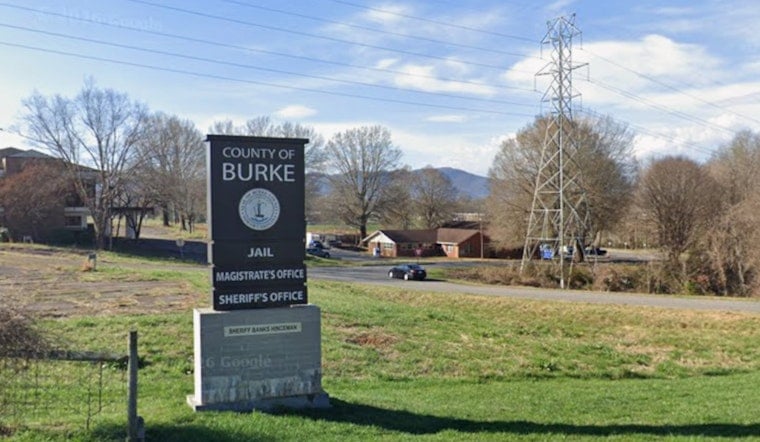
A Morganton man who investigators say sold methamphetamine and fentanyl across Burke and Catawba counties was sentenced yesterday to 14 years in federal prison, capping a probe that began with a tip to local deputies and ended with a federal courtroom reckoning. Rodney Justin Crisp, 38, will also serve five years of supervised release once his prison term ends, after pleading guilty to methamphetamine distribution.
According to the U.S. Attorney WDNC, Crisp entered his guilty plea in January before Wednesday's sentencing. The case traces back to June 2024, when the Burke County Sheriff's Office opened an investigation after receiving reports that Crisp was selling methamphetamine and fentanyl in the two-county area, according to the Department of Justice. Investigators used a confidential informant to make multiple controlled drug purchases from Crisp as the probe developed.
A Traffic Stop Turned Up Fentanyl and Meth
The investigation intersected with a roadside encounter on July 23, 2024, when Burke County sheriff's deputies searched Crisp's vehicle after a K-9 alert during a traffic stop. Per the Burke County Sheriff's Office, deputies seized 28.5 grams of suspected fentanyl and 11.5 grams of suspected methamphetamine from the vehicle. Crisp was released afterward on a $75,000 secured state bond, the sheriff's office said.
More than a year later, on October 13, 2025, deputies executed a federal arrest warrant on Crisp at a Connelly Springs gas station. As reported by The Paper, emergency personnel treated a female passenger who was experiencing overdose symptoms on scene, and deputies recovered 46 grams of methamphetamine inside the vehicle. The arrest underscored how the drugs Crisp allegedly moved were causing harm in real time, not just fueling a distribution network on paper.
Federal Prosecutors Say Case Fits a Pattern
The prosecution was led by Assistant U.S. Attorney Christopher Hess of the Asheville office, following a joint investigation by the Burke County Sheriff's Office and the ATF Charlotte Field Division, the Department of Justice said. U.S. Attorney Russ Ferguson publicly announced the sentencing outcome. Ferguson, who took over leadership of the Western District of North Carolina in March 2025, has made dismantling regional fentanyl and methamphetamine networks a central priority, and he oversees federal prosecutions across 32 western North Carolina counties, as Hoodline previously reported.
Under North Carolina General Statutes Section 90-95, possessing or transporting 28 grams or more of methamphetamine constitutes felony drug trafficking, a threshold that frequently triggers federal adoption of cases involving repeat offenders. Crisp's sentence also lands amid a broader regional crackdown: a multi-agency enforcement operation across Western North Carolina in mid-2026 resulted in federal charges against 56 defendants, the seizure of more than 254 kilograms of drugs, and the recovery of 110 illegal firearms, according to the Department of Justice.
Part of a Wider Crackdown in Burke County
Crisp's 14-year term fits a pattern of heavy federal penalties handed down in Burke County recently. In June, Morganton resident Jordan Cantrell received an 18-year sentence for operating a regional meth ring involving 71 kilograms of the drug, as Hoodline detailed in its report on the case, Feds Nail Morganton Meth Ring. Federal prosecutions across the district have also increasingly targeted dealers moving both methamphetamine and fentanyl together, as seen in an August case where two Charlotte co-defendants received 14-year and 10-year sentences.
Together, the cases point to a sustained push by local and federal authorities to unwind drug networks stretching across Burke and Catawba counties, where local traffic stops and informant-driven buys are increasingly funneled into federal court for the stiffest available penalties.





