

























































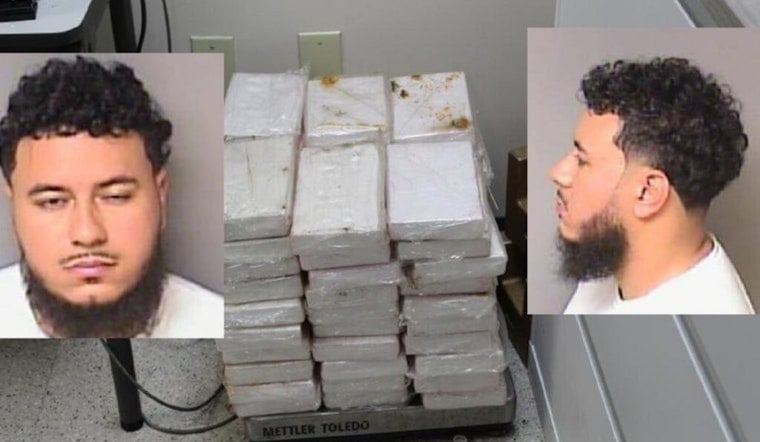
A Morganton man will spend 18 years in federal prison after prosecutors tied him to a sprawling meth pipeline feeding western North Carolina, with court filings pegging his role to repeated kilogram deals across Burke and McDowell counties.
The defendant, 32‑year‑old Jordan Cantrell, was also ordered to serve five years of supervised release once he gets out, according to court records that outline a run of high‑volume trafficking activity across the region.
According to Charlotte Alerts News, investigators used a cooperating individual to set up multiple controlled buys from Cantrell. Those undercover purchases helped agents build a case that ultimately held him responsible for distributing more than 71 kilograms of methamphetamine. Authorities said Cantrell used his residence as both stash house and storefront, storing product and moving it out into the community until his arrest. Reporting on the case links those sales to a wider group of local distributors pushing kilogram quantities into Burke and McDowell counties.
How This Fits Western North Carolina's Meth Crackdown
Federal and local prosecutors in western North Carolina have been leaning hard on multi‑kilogram meth cases, reserving some of their longest sentences for defendants tied to regional distribution networks. A recent press release from the U.S. Attorney's Office, Western District of North Carolina describes an April 2026 sentence of 18 years for a Lenoir man linked to multi‑kilogram shipments into Burke and Caldwell counties.
That office credited coordinated work by agencies including the ATF and local sheriff’s offices for building that earlier case, a familiar blueprint for how big trafficking investigations get done in the western part of the state. The pattern helps explain why prosecutors keep turning to undercover buys, surveillance and multi‑agency task forces when they are chasing large‑scale meth suppliers.
What Cantrell Admitted
Court filings show Cantrell pleaded guilty to conspiracy to distribute and to possess with intent to distribute methamphetamine, along with two counts of possession with intent to distribute. His admitted distribution activity ran from 2023 through 2025 in Burke and McDowell counties, according to Charlotte Alerts News.
The judge imposed an 18‑year prison term followed by five years of supervised release. Those charges, the timeline and the ultimate sentence track with the details laid out in local reporting and in the underlying court documents.
Federal Threat Picture
The Drug Enforcement Administration 2025 National Drug Threat Assessment warns that methamphetamine and other synthetic drugs continue to reshape local drug markets, with organized trafficking groups driving both availability and volatility. That big‑picture assessment helps explain why prosecutors in places like western North Carolina push for multi‑agency investigations and heavy charges when they are looking at kilogram‑level meth cases.
The NDTA’s findings provide the backdrop for prosecutions like Cantrell’s, where local dealing is treated as part of a larger supply chain rather than a stand‑alone neighborhood operation.
Legal Fallout
When a court attributes dozens of kilograms of meth to a single defendant, the potential sentence jumps quickly. Judges typically weigh drug quantity, the reach of the distribution network and any prior criminal history when deciding how many years a defendant will serve.
Prosecutors in the Western District often point to a familiar toolkit for getting there: undercover buys, search warrants and lab testing that can survive a courtroom challenge. The U.S. Attorney’s Office has highlighted that same mix of evidence in similar cases, describing it as the model that local and federal partners rely on to crack larger distribution systems instead of picking off only street‑level dealers.
Public court records will contain the formal plea and judgment in Cantrell’s case. Anyone who wants the official docket can contact the clerk’s office for the court that handled the prosecution. For most readers following along at home, local reporting remains the most accessible window into what the filings and the sentence actually say.





