

























































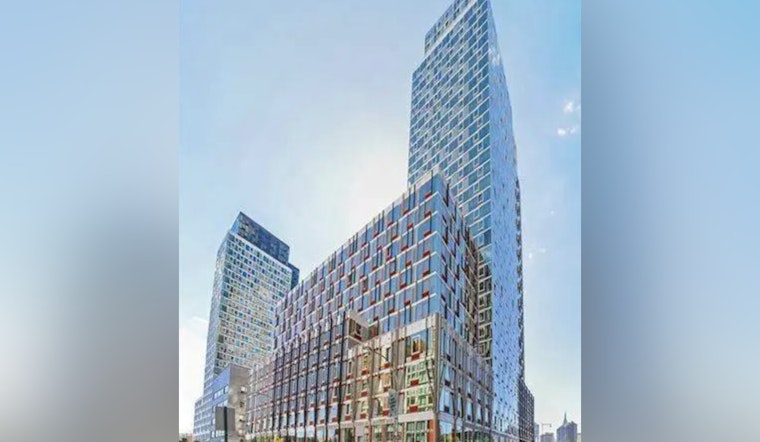
Hunter’s Point South Commons, the 37-story affordable high-rise on the Long Island City waterfront, just locked in a $136.5 million refinancing that keeps its balance sheet on steady ground at a critical moment for the building and for affordable housing more broadly.
Developer Related Companies and partner Phipps Houses closed the new loan through the New York City Housing Development Corporation, which assigned the debt to Fannie Mae. The financing replaces a prior, identical Fannie Mae loan, effectively resetting the capital stack rather than overhauling it. The timing lines up with the property’s long-term affordability schedule, which is backed in part by low-income housing tax credits and is entering a period when preservation decisions are getting harder to postpone.
According to Multi-Housing News, Yardi Matrix data show the transaction as roughly $136.5 million in Fannie Mae bonds, with the new financing described as retiring a previous identical loan. The outlet also notes that while Monadnock Construction was part of the original development team, it does not appear on the latest loan documents in public records. Put together, those details point to a like-for-like refinancing rather than a maneuver to shift the property toward a market-rate strategy.
Public documents cited by industry tracker PincusCo show that the deal closed on January 27, 2026 and was recorded on February 5, 2026, with HPS 50th Avenue Associates LLC listed as the borrower. The outlet reports that the New York City Housing Development Corporation arranged the refinancing and assigned the debt to Fannie Mae, and that Related executive Frank J. Monterisi signed on behalf of the borrowing entity. PincusCo pegs the loan at roughly $261 per built square foot across the tax lot.
Project background
Hunter’s Point South Commons sits in the heart of the Hunter’s Point South waterfront redevelopment, a multi-parcel buildout that has reshaped a big stretch of the Long Island City shoreline. Phase I of the project, which included two residential buildings, broke ground in 2013 and wrapped construction in 2015, with the waterfront park unveiled in 2018, according to NYC HPD.
Developer materials describe 1-50 50th Avenue as a 37-story, LEED-rated community with 619 apartments and roughly 13,739 square feet of retail space, per Related. The property was delivered by a partnership led by Related, alongside Phipps Houses and Monadnock, and was marketed as a mixed-income, permanently affordable anchor for the broader neighborhood plan.
Why the financing matters
The refinancing lands at a time when thousands of low-income housing tax credit apartments across the country are edging toward the end of their initial compliance and extended-use periods, putting pressure on owners and local governments to keep those homes affordable rather than lose them to the market. An affordable-housing bulletin from Yardi Matrix notes that large portions of the LIHTC stock will hit key expiration windows in the coming years, fueling a wave of resyndications and preservation-focused refinancing.
At the same time, federal policy changes adopted in 2025, summarized by groups such as the National Council of State Housing Agencies, permanently boosted LIHTC allocations and lowered the private-activity bond threshold from 50 percent to 25 percent. That shift could make 4 percent LIHTC resyndications and bond-backed preservation deals more feasible for properties like Hunter’s Point South Commons.
For Long Island City residents, the new debt gives Related and its partners a cleaner financial base from which to decide their next move on preservation. Five of the seven Hunter’s Point parcels have already been developed, and the city has issued a request for proposals on another site in the area, signaling that the waterfront’s evolution is far from over. How the partnership ultimately uses this refinancing whether to tackle repairs, pursue a resyndication that extends affordability, or take some other route will shape whether this next chapter locks in permanently affordable homes or simply stretches the current model a bit further.



