

























































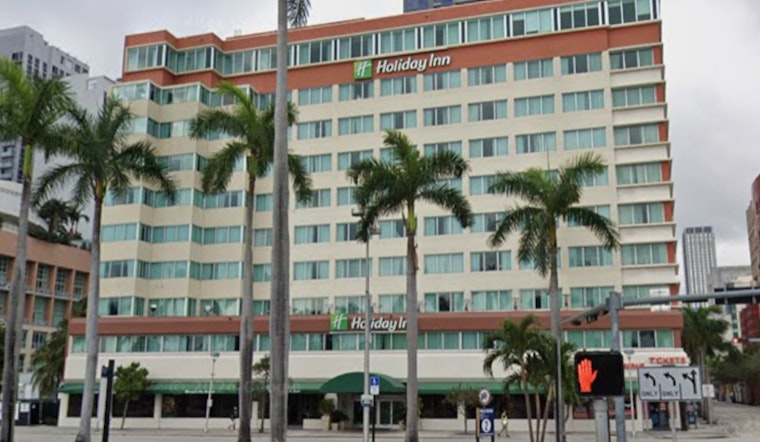
The fight over the Holiday Inn Port of Miami is not over yet. An unsuccessful bidder in the hotel’s bankruptcy sale has come back swinging, asking a federal judge to bless a $107 million all-cash deal that would top the lender’s $95 million credit bid.
The would-be buyer, identified in court papers as 340 Blue Sky LLC, filed an expedited motion in the U.S. Bankruptcy Court in Miami on Feb. 19. The company wants the judge to approve its post-auction purchase and set a quick hearing on the proposal. The offer includes a $5.25 million escrow deposit and a promise to cover up to about $4.8 million in seller closing costs.
Auction Result Draws Scrutiny
The property went back to auction after an earlier sale was voided. When bidding resumed on Jan. 28, the sale reportedly wrapped up in a matter of minutes, with the lender’s $95 million credit bid emerging as the winner, according to Bisnow.
That report notes that Concierge Auctions ran the sale and that the asset — a 100-room Holiday Inn at 340 Biscayne Boulevard — has been marketed primarily as a redevelopment play with much higher potential value than a straightforward hotel deal. In its new motion, 340 Blue Sky points to the lightning-fast, two-party bidding and earlier registration problems as signs that the auction process was flawed and chilled competition.
Post-Auction Offer And Challenge To The Sale
In an expedited filing summarized by Chapter11Cases, 340 Blue Sky attaches a signed purchase agreement for $107 million and asks the court to treat that deal as the “highest and best” offer.
The motion accuses the prior auction of suffering from registration hiccups and other irregularities that, according to the bidder, discouraged would-be participants from jumping in during the resumed sale. The challenge effectively asks the judge to reopen the outcome and swap in the new offer for the lender’s credit bid.
Site, Zoning And Market Context
The underlying dirt at 340 Biscayne is the real star of the show. The nearly 1-acre downtown site has been pitched to developers as a location with approvals for a dramatically larger mixed-use tower, a key selling point that has drawn national attention and fueled aggressive marketing.
Commercial Observer reported last fall that the site was being marketed with a $175 million asking price and entitlements for a high-rise project called Regalia on the Bay. That backdrop helps explain why a losing bidder is now willing to leapfrog the lender’s $95 million credit bid with a $107 million cash offer.
Deal Terms, Deposit And Closing Window
The purchase and sale agreement attached to 340 Blue Sky’s motion is structured as an all-cash transaction with no financing contingency and an outside closing date of April 7, 2026, according to the filing summary.
The buyer has already placed $5.25 million in escrow with counsel and has agreed to pay up to $4,804,648.01 in seller closing costs. That pot, the motion says, includes a 2 percent broker commission and a $750,000 fee to Concierge Auctions.
The agreement also gives the buyer a one-time option to push the closing back by another 30 days, provided it posts an additional $5.25 million deposit.
What Comes Next And The Legal Stakes
Docket entries show the motion to approve the sale was filed as Docket No. 374. The parties also moved to shorten the time for a hearing, and the court has set an expedited hearing in Miami later this week. Inforuptcy lists the recent filings and hearing notices in case No. 24-23028-LMI.
Under long-standing bankruptcy practice, a judge can authorize a sale free and clear of interests under Section 363 of the Bankruptcy Code and can also approve asset transfers as part of a confirmed Chapter 11 plan under Section 1129. The new motion leans on both provisions.
The relevant statutory language for sale approvals appears in 11 U.S.C. § 363 and 11 U.S.C. § 1129, available through Cornell Law School and Cornell Law School, respectively.
The filing also contemplates the possibility of structuring the transfer under a Chapter 11 plan that could qualify for transfer-tax benefits under Section 1146. Courts and practitioners treat that topic cautiously, since timing and the exact form of the transfer determine whether transfer taxes are actually avoided. For a discussion of how Section 1146 exemptions are applied in real-world deals, the motion points to analysis from title-insurance professionals at Stewart Title.
If the judge signs off on the 340 Blue Sky deal, it would replace the lender’s credit bid as the winning outcome and route the $107 million through the Chapter 11 process, with valid liens shifting from the property to the sale proceeds in their current order of priority.
If the court denies the motion, the lender’s $95 million credit bid will remain the deal to beat, and any objections from other creditors or interested parties will stay front and center as the court decides how to wind down or redevelop the high-profile downtown site.





