

























































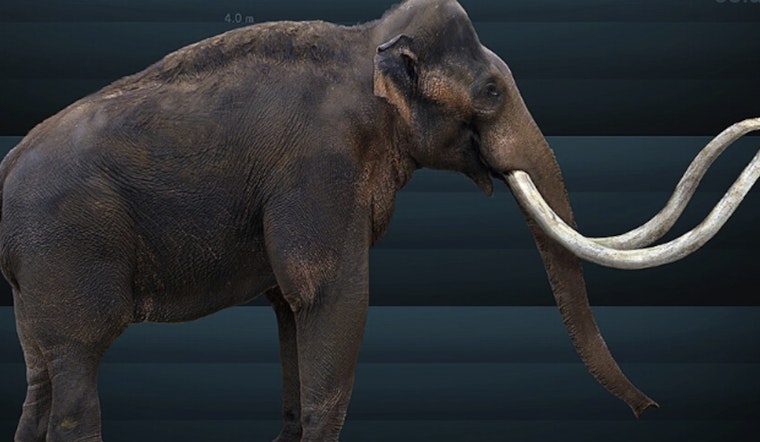
On Feb. 13, a northwest Missouri fossil hunter waded into a shallow, brush-lined pond and hauled out a 92-pound femur he says belonged to a Columbian mammoth. The bone is thicker than an adult thigh, and Jason Howery said it felt “sticky and glassy” when wet, a texture he associates with Ice Age material.
Video of the recovery, shared with Storyful, shows the man heaving the long bone up to his chest. The clip was picked up by national outlets including People, helping the find jump from local TV coverage to social feeds where viewers quickly started arguing over whether the monster femur came from a mammoth or a mastodon.
([video.storyful.com](https://video.storyful.com/record/38330?utm_source=openai))
Where It Came From
According to KMBC, Howery said he first spotted the bone protruding from shin-deep water near Ravenwood in Nodaway County. After probing along the edge of the pond for about 30 minutes, he stepped in and pried it free. A local scale later put the femur's weight at roughly 92 pounds, and Howery told reporters the mineralization and staining matched other Ice Age material he had previously documented in the area.
([kmbc.com](https://www.kmbc.com/article/missouri-man-pulls-mammoth-femur-from-northwest-missouri-waterway/70485197))
Preserving And Testing The Bone
According to GoFundMe, Howery has raised a few hundred dollars toward a $4,500 goal to pay for a CT scan, radiocarbon dating and stabilization work so professionals can document and preserve the specimen. He says those tests are needed to confirm the bone's age and species and to make the find available for educational programming through his Paleo Outreach Program.
([gofundme.com](https://www.gofundme.com/f/preserve-a-mammoth-discovery-inspire-scientists?utm_source=openai))
What The Science Will Show
The National Park Service notes that Columbian mammoths once ranged across much of North America and disappeared at the end of the last Ice Age, which is why radiocarbon dating of preserved collagen is the standard way to place a bone in time. National Geographic explains that radiocarbon results must be carefully pretreated and calibrated, and that CT imaging is commonly used to map internal structure without damaging fragile fossils.
([nps.gov](https://www.nps.gov/articles/000/columbian-mammoth.htm?utm_source=openai))
Howery told KMBC that he hopes the discovery will be verified by labs and then used to inspire students to get outdoors and learn science firsthand. Until CT imaging and radiocarbon results arrive, the 92-pound bone will remain an intriguing candidate for a Columbian mammoth and a local reminder of the deep history beneath Missouri's fields.
([kmbc.com](https://www.kmbc.com/article/missouri-man-pulls-mammoth-femur-from-northwest-missouri-waterway/70485197))





