

























































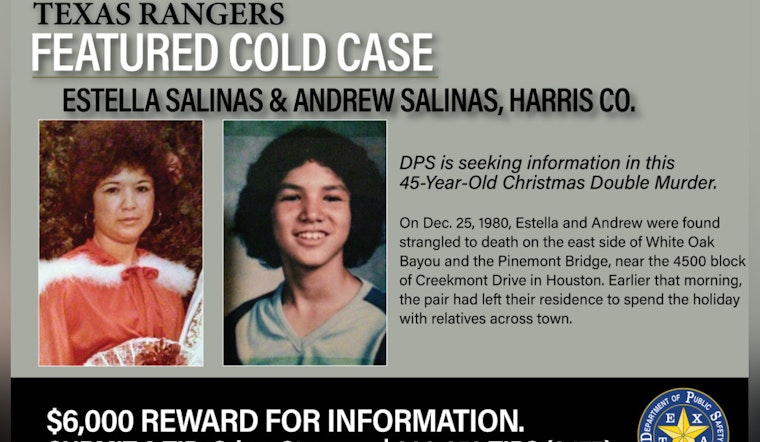
Forty‑five years after a Houston mother and her teenage son were found strangled along a bayou on Christmas Day, state investigators are taking another run at the case with fresh DNA testing and a new push for public tips. Evidence from the Dec. 25, 1980 killings of 31‑year‑old Estella Salinas and her 14‑year‑old son, Andrew, has been resubmitted for modern DNA analysis, and the Houston Police Department and the Texas Rangers are again asking anyone with information to come forward. That same morning, family members later found Estella’s blue 1972 Mercury Cougar abandoned with the keys and personal items still inside. No arrests have ever been made.
In a Feb. 12 news release, the Texas Department of Public Safety said the Salinas case is now being featured through the Texas Ranger Unsolved Crimes Investigation program. Texas Crime Stoppers has increased the reward to up to $6,000 for eligible tips submitted before the program’s next featured case. The department described the effort as a bi‑monthly campaign to generate new investigative leads after older evidence was re‑examined using updated DNA techniques.
Earlier reporting and agency case files indicate Estella and Andrew were last seen near a McDonald’s at Cavalcade and the US‑59 northbound frontage road. Their bodies were later discovered on the east bank of White Oak Bayou near the Pinemont Bridge, around the 4500 block of Creekmont Drive. Family members found Estella’s blue Mercury Cougar parked near Cavalcade and the Eastex Freeway with the victims’ belongings still inside, and interviews with witnesses over the years have yet to produce an arrest, as reported by Click2Houston.
Why Modern DNA Can Change Cold Cases
Advances in laboratory extraction and investigative genetic genealogy have allowed law enforcement to pull usable DNA profiles from degraded evidence and then trace familial leads when there is no direct match in criminal databases. The U.S. Department of Justice issued interim guidance on forensic genetic genealogy to spell out safeguards and best practices for the method, according to the Department of Justice. Federal programs also support processing cold‑case DNA and prosecuting cases that develop from that work, per the Bureau of Justice Assistance.
How To Share Tips
To qualify for the increased reward, tipsters must call the Texas Crime Stoppers hotline at 1‑800‑252‑TIPS (8477) or submit a tip online through the Crime Stoppers portal and select “Cold Cases Featured” and “Cold Case” in the form, the Texas Department of Public Safety said. Tips can be submitted anonymously, and tipsters may receive a tip number for follow‑up, as local reporting has noted from Click2Houston.
Legal Note And Next Steps
Under Texas law, murder carries no statute of limitations, which means charges can be filed at any time under Article 12.01 of the Texas Code of Criminal Procedure. Local outlets and the state release say the Houston Police Department and Texas Rangers remain actively involved in the investigation while DNA testing continues, as reported by KHOU.





