

























































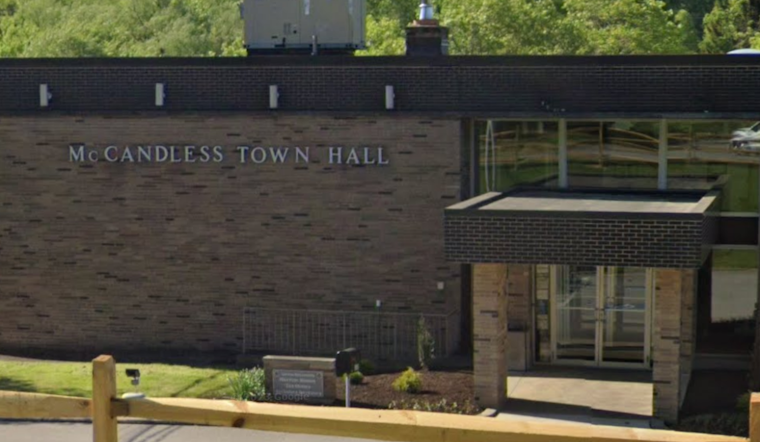
McCandless Town Council has voted to pull the plug on local cooperation with U.S. Immigration and Customs Enforcement and Customs and Border Protection on civil immigration cases, setting off one of the North Hills' sharpest policy debates in recent memory.
Yesterday, the council approved the resolution in a 5-2 vote, putting the township among a small but growing number of Pittsburgh-area municipalities formally limiting their role in federal immigration enforcement. Council President Trish Cloonan joined Laureen Alt, Nathan Babich, Nick Giorgetti, and Jack Hickerson in support, while Doug Arlow and Joe Wall opposed the measure, according to WESA. Cloonan said the goal was “keeping McCandless police doing McCandless police business, and that is all.” Council members told the station they had been flooded with input ahead of the vote, with hundreds of emails and dozens of residents weighing in.
The meeting itself drew a standing-room-only crowd of about 100 people and ran more than two hours as roughly 40 residents stepped to the microphone, according to WTAE. Speakers were sharply split. Opponents urged the council to stick to what they saw as core local concerns and warned the resolution could complicate coordination with federal authorities on criminal investigations. Supporters recounted negative experiences with ICE and argued that limiting civil immigration cooperation would help build trust between immigrant residents and local police.
What the resolution does
The text of the resolution emphasizes that McCandless will “continue to enforce any criminal warrant or court order legally issued from a detached judge or judicial officer.” At the same time, the town will not “enable or assist ICE or CBP related to civil law enforcement” and will decline to enter into 287(g) agreements, WESA reports.
Under 287(g), selected and trained local officers can be deputized to carry out certain federal immigration functions. Both critics and supporters say such arrangements change how police prioritize stops and arrests, which is exactly the kind of shift McCandless council members were debating.
Part of a regional shift
McCandless is not moving in a vacuum. Across Allegheny County, local leaders have been wrestling with how closely to work with federal immigration agencies.
In nearby Coraopolis, officials recently reversed course and scrapped a newly announced partnership with ICE after residents pushed back, according to Pittsburgh's PublicSource. At the county level, lawmakers have been considering rules that would limit when employees can ask about a person's immigration status, WPXI reported.
The result is a patchwork of local approaches that all circle the same question: how much should hometown cops be involved in federal immigration business.
What it means legally
The McCandless resolution is a statement of local policy, not a legal wall. It cannot stop ICE or CBP from operating in or around the township. Instead, it signals that McCandless officers will not proactively take part in civil immigration enforcement, according to ICE.
Legal scholars have long noted that 287(g) and similar partnerships can reshape the scope of local policing and influence how comfortable residents feel reporting crimes or interacting with officers. Those are among the arguments lawmakers and residents weighed in McCandless, as outlined by the Columbia Law Review.
Council members who backed the resolution said, according to CBS News Pittsburgh, that it largely formalizes how the McCandless Police Department already operates. Opponents countered that the move strays into federal territory and risks unnecessary conflict over immigration policy. With McCandless now on the record, the broader fight over immigration and local policing is likely to keep simmering in neighboring boroughs and at the county level in the weeks ahead.





