

























































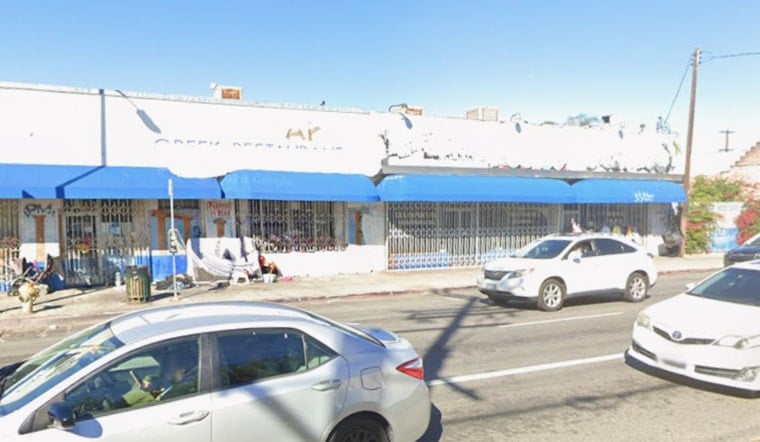
The former home of Papa Cristo’s, a longtime Pico Union landmark, is being teed up for a major reinvention: a multistory self-storage complex with ground-floor space that could host a smaller market or community hub. The proposal, now making the rounds at neighborhood meetings, would demolish the existing building, stack storage on the upper floors and add sidewalk upgrades and a new bus stop along the corner. The catch? Locals are sharply divided between those who want housing and those who say a commercial reuse is better than a vacant corner.
At recent community presentations, consultant Brian Sorenson of La Tierra Consulting laid out three design concepts and argued the area is “heavily underserved” when it comes to storage, according to LAist. The development team told attendees that customers would drive in from the rear of the property to a covered loading zone for moving trucks, while the upper floors would be strictly storage. The highly visible corner would stay active with retail or other community-serving uses. Security features pitched to neighbors include gated entry, keypad access, elevator-code controls and around-the-clock monitored cameras.
The building at 2771 W Pico Blvd hit the market last year for $5.2 million, and the restaurant itself closed in 2025 after more than seven decades in business, per Eater LA. Papa Cristo’s built its reputation on dishes like rack of lamb, kebabs and a well-stocked Greek market, and the family has continued to sell some of its products online since shutting the doors. The sale and closure turned the corner into a kind of Rorschach test for Pico Union’s future as nostalgia, development pressure and preservation instincts all collide.
Designs And Street-Level Plans
Design boards shown in community meetings feature three distinct looks: a sleek contemporary façade, a brick-heavy scheme that nods to the nearby high school and a neo-industrial version that riffs on surrounding historic buildings, according to The LA Local. In all three versions, the corner stays lined with retail or other public-facing uses, while a six-foot dedication along both Pico and Normandie would widen sidewalks and potentially make room for broader street improvements. Developers say building housing on the compact lot is tough given parking rules and land costs, which is why a storage-focused project pencils out more easily in their view.
Community Reaction And Council Support
Neighbors have not exactly marched in lockstep. Some residents pushed for apartments instead, arguing the neighborhood needs more housing than storage. Others pointed to everyday needs like safer sidewalks, a refreshed corner and somewhere to stash boxes and furniture as reasons to get behind the plan. The Pico Union Neighborhood Council ultimately voted 10-0 to support the proposal, and the Byzantine Latino Quarter Pico Business Improvement District backed it as well, LAist reported. BID manager Stephen Post said he would prefer housing on the site but acknowledged there is only so much sway the community has over private development, while BID president Vanessa Rivera credited the developers for taking feedback seriously and coming back with multiple design options.
What’s Next
The property is currently in escrow with a Redondo Beach–based developer, and the project still faces city review and permitting before any demolition or construction can move forward, The LA Local notes. If the proposal advances, expect more design hearings along with environmental and zoning scrutiny that could tweak, trim or reshape the plan. Until then, the shuttered restaurant site remains a symbolic battleground between efforts to honor a beloved L.A. institution and the market forces rapidly reshaping Pico Union.





