

























































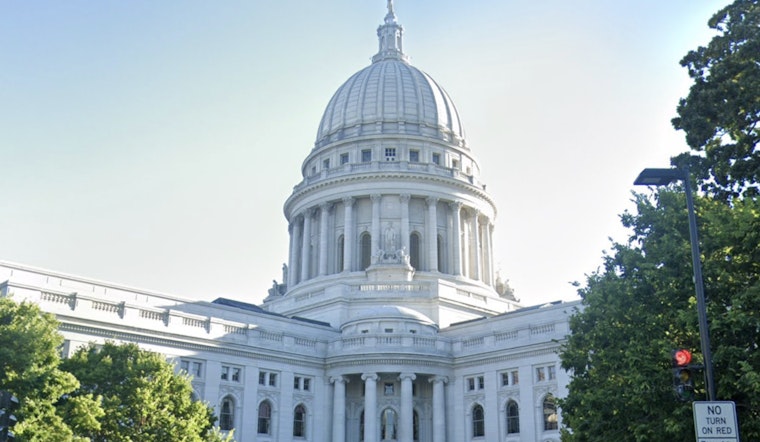
Wisconsin’s long-running fight over who pays for public schools just jumped from the Capitol to a courtroom in Eau Claire.
A coalition led by the Wisconsin Parent Teacher Association filed a 105-page lawsuit Monday in Eau Claire County Circuit Court, accusing the state Legislature of systematically underfunding public schools and shortchanging students on their constitutional right to a “sound basic education.” The plaintiffs, a mix of school districts, teachers unions, parents and students from around Wisconsin, argue that decades of policy choices and lagging state support have stripped down classroom services and pushed more of the bill onto local property taxpayers. They want the court to order up a new statewide funding system if lawmakers do not do it themselves.
As reported by Urban Milwaukee, the 19 plaintiffs include the Adams-Friendship, Beloit, Eau Claire, Green Bay and Necedah school districts, the Wisconsin Public Education Network, local unions and eight individual parents and students. The complaint ties declining student proficiency, including fourth-grade reading and eighth-grade math scores, to a long-term drop in the state’s share of school funding, which it says fell from about 53.7% in 1999–2000 to roughly 45% by 2023–24.
Jeff Mandell, president and general counsel at the legal nonprofit Law Forward, has cast the filing as a direct constitutional challenge to Wisconsin’s school-finance system. “When schools are underfunded, students lose opportunities and communities suffer,” Mandell said, according to the Associated Press.
The plaintiffs have posted the full complaint and supporting materials on a coordinating site, Fund WI Public Schools, which lists Law Forward and the Wisconsin Education Association Council as counsel. The site includes the complete filing along with the roster of districts, unions and individual plaintiffs for anyone who wants to dig through the details.
What the complaint says is broken
The lawsuit levels several constitutional claims at the Legislature’s finance system. It argues that the current structure fails to provide students across Wisconsin with an equal opportunity for a “sound basic education,” that it is not “nearly as uniform as practicable,” and that the reimbursement rate for special-education services is so low it violates state constitutional standards. Those claims, along with the list of defendants, are laid out in coverage by WTAQ, which notes that the Assembly, the Senate and members of the powerful Joint Committee on Finance are all named in the suit.
The plaintiffs say the current arrangement leaves students’ opportunities heavily dependent on local property wealth, with some districts cutting programs and staff while others can pass referendums to paper over gaps. In their view, that patchwork is exactly what the state constitution was written to avoid.
Where the case is likely headed
The case starts in Eau Claire County Circuit Court, but legal observers expect it to make its way to the Wisconsin Supreme Court, according to the Associated Press. The high court has been here before: in the 2000 decision Vincent v. Voight, justices upheld the state’s funding formula while spelling out Wisconsin’s obligation to provide a “sound basic” education, a standard detailed in records from the Wisconsin Court System.
Republican leaders who were contacted by reporters did not immediately respond, and the Assembly adjourned last week without agreeing to use a roughly 2.5 billion dollar state surplus to boost school funding, according to Wisconsin Public Radio. After a lawsuit is filed, the court assigns a judge and defendants typically have about 45 days to respond under standard procedures cited in local reporting.
Plaintiffs say they turned to the courts because budget negotiations in Madison have hit a wall and they see no other way to force a comprehensive redo of the system instead of continuing with one-off fixes every two years. Court dockets and the full complaint are available for public viewing through the coordinating site and the usual circuit-court records, for anyone who wants to follow what could become Wisconsin’s next big school-funding showdown.





