

























































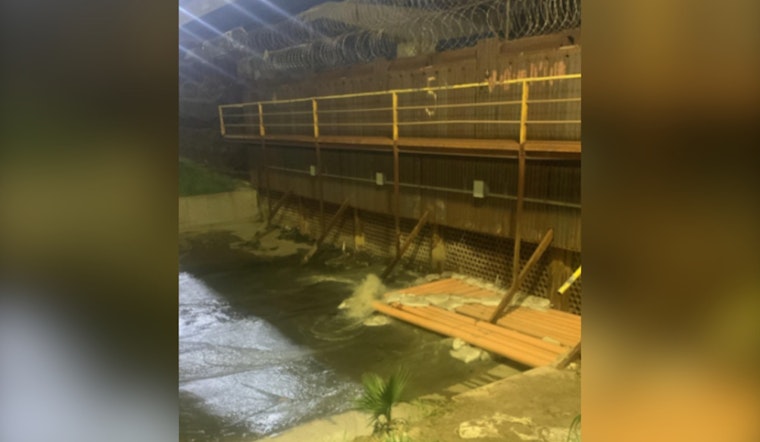
Before dawn on Tuesday, a temporary bypass pipe gave out near the border, sending an estimated 36,000 gallons of wastewater surging through Stewart's Drain just south of San Ysidro. Crews on both sides of the border scrambled with portable pumps and vacuum trucks, ultimately capturing most of the flow before it could hit the Tijuana River channel, according to authorities. Officials added that the South Bay International Wastewater Treatment Plant kept running normally while teams handled repairs and cleanup.
The U.S. International Boundary and Water Commission said the rupture hit around 5 AM along a bypass line routed around Junction Box 1 (JB-1). Workers had already placed backup pumps in Stewart's Drain ahead of final installation work. According to the agency, the dry-weather transboundary flow was shut down by about 6:30 AM, crews had the ruptured line fixed by roughly 9 AM, and cleanup wrapped up around 10 AM as recovered material was removed. These details were reported by 10News.
USIBWC figures show that about 36,000 gallons passed the weir at Stewart's Drain but stopped short of the Tijuana River channel. The agency reported no impacts to operations at the South Bay facility. Contractors, including Veolia and Mexico’s international boundary and water commission, assisted in the response, and portable equipment was used to recover most of the spill. FOX 5 San Diego noted that the agency is urging residents to sign up for email updates through its website.
Response on the ground
USIBWC crews said they had staged backup pumps precisely because they expected possible flows during the work, but the sudden failure of the bypass line briefly overwhelmed that setup and allowed wastewater to slip past the low dam just north of Stewart's Drain. Response teams then moved quickly to contain the spill and vacuum out material from the channel area. Officials said they are still calculating how much of the spilled volume was ultimately recovered. These response actions and the timeline were reported by the Coronado Times.
Why it matters
The rupture is the latest chapter in a long-running cross-border sewage crisis that has repeatedly fouled beaches and stoked health concerns across South County. Regulators and federal agencies have been pushing upgrades and emergency measures, including a Tentative Order to update the South Bay plant’s permit and binational projects to increase capacity, in an effort to cut down on these kinds of releases. Those steps are outlined by the San Diego Regional Water Board and reported locally by KPBS. Hoodline's earlier coverage has also tracked previous breaks and repair projects in the valley, underscoring that this is part of a repeating pattern of failures followed by fixes.
Residents who live near the canyon collectors say the spills have become alarmingly routine. "Pathogens are being spread through our community," physician Kimberly Dickson told 10News, warning that polluted water and wildlife can carry contamination back into nearby neighborhoods.
What regulators are doing
The Regional Water Board has posted materials describing a tentative permit change for the South Bay plant. The proposal would authorize interim increases in treatment capacity, require a Treatment Optimization Report, and update effluent limits and reporting requirements for the facility. Federal and binational agreements and related funding are aimed at expanding conveyance and treatment capacity over the coming years, steps that officials say should reduce the odds of similar spills during ongoing repair and construction work.
USIBWC said it will continue to keep an eye on the canyon collectors and post public updates while crews finish assessing damage. The agency again urged residents to subscribe to email alerts on its website. Officials said they will keep refining the estimate of recovered volumes and share those figures through local channels as more information becomes available, according to local reports.





