

























































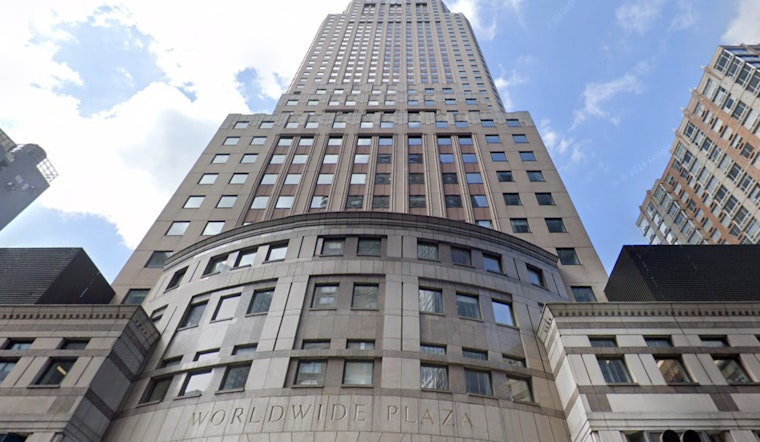
Worldwide Plaza, the 49‑story, roughly 1.8‑million‑square‑foot office tower at 825 Eighth Avenue in Midtown, is suddenly looking less like a trophy and more like a battleground. Senior lenders led by Goldman Sachs and Deutsche Bank have moved to foreclose on the property, asking a judge to order a sale and install a receiver to run the building while a bitter ownership fight among SL Green, RXR and mezzanine lenders plays out. It is the latest escalation in a months‑long scramble over debt, tenants and what the tower is actually worth.
Who filed and what they want
Goldman Sachs, Deutsche Bank and a trustee for CMBS bondholders filed a complaint this week in New York State Supreme Court, accusing the joint‑venture owners of defaulting on roughly $940 million in senior debt and asking for court intervention. According to The Real Deal, the lenders want a temporary receiver appointed and a court‑authorized foreclosure sale to pay off the loan. The complaint also claims that the sponsors, SL Green and RXR, along with New York REIT Liquidating LLC, guaranteed remaining obligations tied to the financing.
What the lenders are asking the court
The senior lenders are asking the court to drop Worldwide Plaza into receivership and set a foreclosure schedule that could end in a judicial sale, according to Commercial Property Executive. That path would be their main way to claw back value and could sideline or reshape the separate UCC foreclosure that a mezzanine lender has been pursuing. The filing also states that if the sale price falls short of the loan balance, any deficiency would be the responsibility of the sponsor guarantors, as outlined in the complaint.
Debt stack and the UCC fight
The lawsuit traces the capital stack to a 2017, 10‑year fixed‑rate financing package, divided into roughly $705 million of CMBS debt and a $235 million companion loan, according to PincusCo. The loan landed in special servicing after law firm Cravath vacated about 617,000 square feet, and the borrowers allegedly began missing or only partially paying required interest in 2025. That deterioration opened the door for a mezzanine lender, now controlled by Extell Development, to push a UCC foreclosure on the entity that owns the building, while the senior lenders opted for a judicial foreclosure route.
Why the building is distressed
An April appraisal chopped Worldwide Plaza’s value to roughly $345 million, an almost 80 percent plunge from the $1.7 billion valuation tied to the 2017 purchase, according to Bisnow. Recent figures put the complex at about 63 percent occupancy. Nomura, the largest remaining tenant, has also indicated it plans to shrink its footprint by roughly 75,000 square feet as early as 2027. The shrinking rent roll, paired with heavy leverage, has left the loan underwater and raised the stakes for both bondholders and owners.
Owners push back
SL Green has publicly framed the foreclosure filing as more procedural than apocalyptic, saying ownership is “working collaboratively toward a resolution,” while RXR has not issued a detailed public response, according to reporting. In a statement to The Real Deal, an SL Green spokesperson said the company “has a plan to revitalize the building and capital to execute it.” The owners previously went to court to block Extell’s UCC auction and have appealed a judge’s ruling that allowed that auction to move forward. The mezzanine holder has a limited window to answer that appeal.
What happens next
For now, the property is caught between two legal tracks: a relatively fast UCC foreclosure on equity interests and a slower, mortgage foreclosure on the real estate itself. As PincusCo notes, Extell has only a short interval to respond to the appeal over the UCC sale while the senior lenders press state court to install a receiver and greenlight a sale. If a receiver is appointed, that party would oversee day‑to‑day operations and cash flow while the court sorts out competing claims and creditor priorities.
Legal implications
If the judge sides with the lenders, a receiver could ultimately sell the tower and the owners could still face liability for any remaining debt under the guarantees, a potentially large hole given the drop in valuation, according to Bisnow. That outcome would also likely mean steep losses for some CMBS bondholders and serve as another warning about how sharply New York’s office market is repricing former trophy assets after major tenant exits. For now, the case moves forward in Manhattan Supreme Court while the parties keep negotiating behind the scenes.





