

























































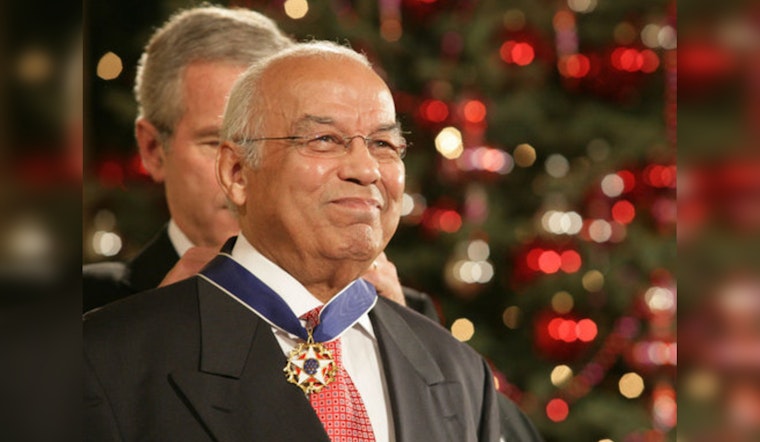
Dr. Norman C. Francis, the civil-rights-era leader who steered Xavier University of Louisiana for nearly half a century, died Wednesday in New Orleans at age 94. Over his 47-year tenure, he turned Xavier into a national pipeline for Black medical and health professionals and became a fixture in the city’s civic, business and political circles.
According to Verite News, Francis died early Wednesday morning at Ochsner Medical Center. The outlet reported that the news came from a statement issued by his family.
In that statement to Verite News, the family said his passing came "with heavy hearts filled with love and gratitude." The outlet noted that Francis became Xavier's president in 1968 as the university's first Black and lay leader, and that over the years he advised eight U.S. presidents. Former mayor Mitch Landrieu told Verite that Francis "treats every human being with dignity and respect," a description that doubled as a kind of civic shorthand for his reputation in New Orleans.
Xavier's medical ambition and legacy
Under Francis, Xavier added permanent dormitories, a college of pharmacy and new science facilities, while enrollment climbed. Those bricks-and-mortar expansions helped solidify the university's role in sending Black students into medical and health careers across the country.
That trajectory continues with the Xavier Ochsner College of Medicine, a downtown medical school announced in 2024 by Ochsner Health and Xavier. Officials say the new school is designed to help diversify the physician workforce, extending the kind of mission Francis championed throughout his presidency.
Katrina, recovery and a contested program
After Hurricane Katrina, Francis took on one of the toughest assignments in the state, chairing the Louisiana Recovery Authority and pushing to reopen Xavier for the spring 2006 semester. Those moves were widely credited with stabilizing the campus in a chaotic period, according to Black Catholic Messenger.
The broader recovery effort was far from universally praised. Critics argued that the Road Home program the authority oversaw left poorer, disproportionately Black neighborhoods struggling to rebuild. An analysis by ProPublica found that grants covered a smaller share of rebuilding costs in lower-income areas than in wealthier communities.
Francis retired in 2015 after 47 years as Xavier's president, a run that brought him national recognition, including the Presidential Medal of Freedom, as noted by FOX 8. As New Orleans and Xavier absorb the news of his death, his imprint on the city, from scholarships and dormitories to a new medical college, is set to endure for decades.





