

























































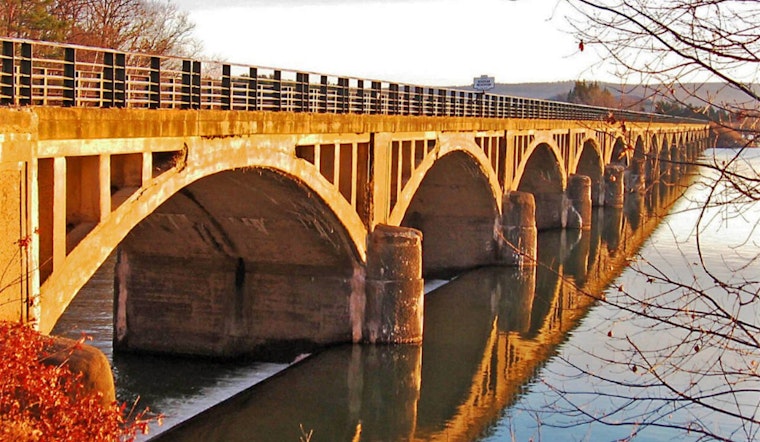
After a late winter stretch of heavy snow and rain, the Ashokan Reservoir has surged back to near spillway levels, giving New York City some rare breathing room on its drinking water supply and clearing the way for long‑planned repair work. Instead of fretting over shortages, managers can now think about taking key pieces of the system offline for maintenance. City officials are looking to fold that timing advantage into a broader ten‑year capital push that would shore up dams, dikes, bridges and water mains. Around the Catskills reservoir, residents are already seeing construction gear and trail upgrades tied to the coming overhaul.
According to Hudson Valley One, Department of Environmental Protection (DEP) data show Ashokan jumping from about 96.2 percent full on Friday to roughly 98.6 percent by Tuesday, part of a broader rebound that pushed several upstate reservoirs above their typical March levels. The outlet reports that the 2025–26 season delivered an unusually deep snowpack followed by a burst of early March storms that fed the reservoir’s comeback. That quick recovery eased pressure on managers who had been keeping a close eye on spillways and downstream releases earlier in the winter.
Why officials want to move now
The current high water levels give DEP a rare opportunity to schedule repairs, test spillways and reduce the risk of emergency releases without cutting into the city’s supply. DEP projects make up a hefty share of New York City’s multi‑year capital commitments, and city finance documents show the agency routinely accounts for tens of billions of dollars in ten‑year plans. That concentration of need is a big part of why fiscal analysts say a front‑loaded wave of upgrades makes sense, according to NYC Comptroller.
What’s in the 10‑year plan
The outline reported by Hudson Valley One sketches out nearly $34 billion in water‑system work. Roughly $14 billion would go toward water‑pollution control projects, about $9 billion toward sewer upgrades and expansions, and around $7 billion toward water‑main improvements. Another $2.4 billion is pegged for keeping drinking water safe and reliable, about $1.3 billion for equipment, and roughly $1 billion specifically for Ashokan Reservoir upgrades, including dams, dikes, control systems and monitoring. DEP officials say the package is designed to protect water quality for the city’s 8.4 million water users while bringing a century‑old system into modern shape.
Local projects in motion
Some of the work has already moved off the drawing board. DEP has announced a $33 million project in Boiceville to replace two Route 28A bridges, rebuild a stretch of roadway and expand the Ashokan Rail Trail trailhead, according to NYC DEP. The agency has also launched multi‑hundred‑million‑dollar efforts to rehabilitate Ashokan’s dam and water‑control infrastructure, including an earlier $750 million upgrade program announced in 2017 in a NYC DEP release. Taken together, those local projects are supposed to protect water quality while making it easier for both recreation users and maintenance crews to access the reservoir area.
What it will mean for ratepayers
All that concrete and steel has to be paid for somehow. DEP’s capital and operating costs are covered largely by water and sewer users rather than general city tax revenue, and recent city filings show the agency’s big construction agenda is a major driver of ten‑year borrowing and authorization levels. That mix of ratepayer funding, bond finance and long construction timelines will shape the coming political fights over how quickly projects move and whether water rates or other revenue streams need to rise. Fiscal watchdogs are already flagging the trade‑offs between speeding up repairs and the price that customers and taxpayers will ultimately shoulder, with the fine print laid out in the city’s budget reports, according to NYC Comptroller.
The Ashokan rebound does not wipe away decades of deferred maintenance, but it does give city engineers a crucial window to push a sweeping upgrade plan without flirting with shortages. How fast that work actually happens, and how much of the bill lands on ratepayers, will be the central argument as contracts are signed and designs move from planning boards to construction sites over the next several years.



