

























































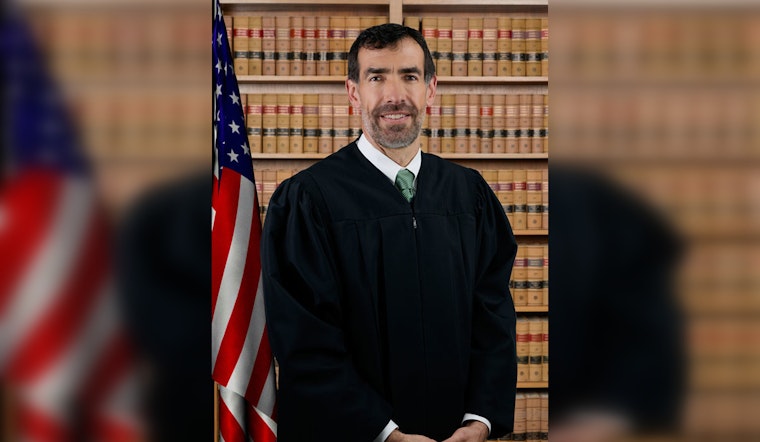
On Monday, a Fulton County judge gave Georgia’s State Board of Pardons and Paroles the green light to move ahead with a condemned man’s final clemency hearing, even as he ordered one board member to step aside over concerns she could not be seen as impartial. The ruling lifts a temporary court-ordered pause that had frozen both the clemency proceeding and any scheduling tied to a potential execution.
Judge Allows Board To Proceed, Orders Recusal
Fulton County Superior Court Judge Robert McBurney found that parole board member Kimberly McCoy has a conflict of interest because of her close relationship with the victims’ families. He noted that McCoy had been too closely tied to the case to qualify as a neutral decision-maker and wrote that “McCoy does not fall into that category.”
McBurney rejected the defense team’s broader argument that clemency must be handled only by a full five-member board, concluding instead that Georgia law permits a quorum to act. As reported by The Atlanta Journal-Constitution, the ruling effectively clears the way for the remaining board members to hear the case.
Case History And Earlier Pause
The inmate, Stacey Humphreys, was convicted in 2007 for the 2003 murders of Cyndi Williams and Lori Brown at a model home in Powder Springs. An execution date set for December 2025 was put on hold after his attorneys raised alarms about board members’ ties to the prosecution.
The Associated Press reported that McBurney issued a temporary hold in late December while lawyers argued whether two board members should be disqualified. In response, the State Board of Pardons and Paroles posted a notice postponing the specially called clemency meeting. Hoodline followed the local fallout from that move in a story highlighting how the board suspends execution.
Why The Recusal Was Ordered
In his order, McBurney explained that McCoy had previously worked as a victim advocate in the Cobb County district attorney’s office during Humphreys’ prosecution and “sat with the families at trial.” That past role, he said, created an appearance that she could not approach Humphreys’ clemency request with the required distance.
The judge drew a line between McCoy and another parole board member, Wayne Bennett, whom he viewed as more remotely connected to the case. McBurney declined to disqualify Bennett, concluding that his ties were not close enough to undermine confidence in his neutrality. The details of the order and McBurney’s reasoning were reported by The Atlanta Journal-Constitution.
Legal Implications
Under Georgia’s constitution, clemency power rests with the State Board of Pardons and Paroles, and “a majority shall decide the action of the Board,” language reflected in the state’s official state records. In practice, that has long been read to mean that a simple majority of the five-member board, typically three members, can decide clemency.
Judge McBurney acknowledged that letting a partial board act in such a high-stakes case would be unprecedented in Georgia, but he concluded that the constitution’s wording allows it. The Associated Press has also reported that three votes are required to grant clemency in the state.
What’s Next
With the injunction lifted, the ball is now squarely in the parole board’s court. Members can opt to move forward with a quorum or hold off until any new appointments are made, a choice that will directly affect how soon Humphreys’ clemency petition and any execution date are resolved.
For the moment, the case shifts back into the slow grind of legal procedure, with lawyers for both sides and the board itself expected to trade filings and coordinate schedules as they edge toward a final decision.





