

























































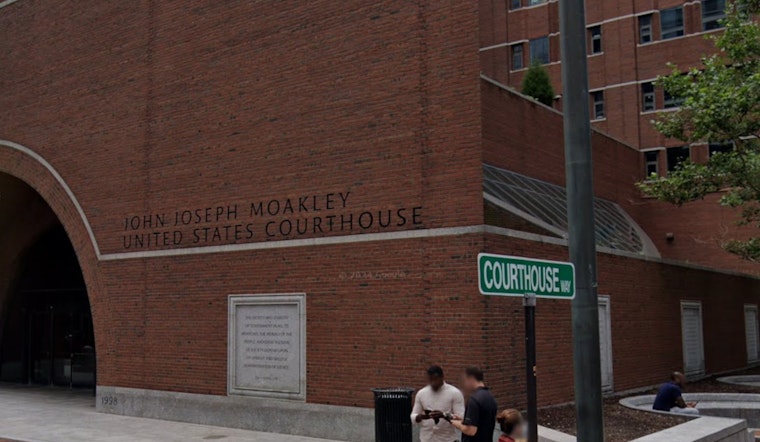
A Boston man serving life without parole for the 2019 killing of Jassy Correia is now asking the U.S. Supreme Court to step in, arguing that federal prosecutors stretched a brief encounter into a full-blown kidnapping case.
On Thursday, federal public defender Christine DeMaso filed a petition urging the justices to review the conviction of Louis D. Coleman III. She contends that lower courts misapplied an eight-decade-old Supreme Court test from Chatwin and that the roughly 12 minutes prosecutors say involved sexual assault and strangulation cannot legally be turned into a separate federal kidnapping. Coleman was convicted in 2022 and is serving life without parole. If the Supreme Court takes the case, it would be to decide a narrow legal issue with outsized implications for how the federal kidnapping statute gets used.
In a filing first reported by The Boston Globe, DeMaso argued that the First Circuit embraced an interpretation of Chatwin that breaks from other federal appeals courts and creates a circuit split that warrants Supreme Court review. She asked the justices to clarify whether the statute's required "appreciable period" of restraint has to be distinct from any contemporaneous assault or homicide.
What the appeals court said
The First Circuit upheld Coleman's conviction, finding that a reasonable jury could conclude Correia was held for an appreciable period during a stop on Tremont Street. In its 2025 opinion, the court detailed surveillance video, location data and receipts that traced Coleman from Boston to his Providence building and then to a traffic stop in Delaware where investigators found Correia's remains. The panel rejected an "incidental kidnapping" exception, concluding that Chatwin's warning about overbroad prosecutions did not require subtracting the time used to commit related crimes, as the appeals court laid out in the First Circuit opinion.
Conviction and sentence
Coleman was convicted by a federal jury in June 2022, and in October 2022 a judge imposed the statutory life sentence without parole. The Department of Justice pointed to surveillance, forensic and other evidence that supported the prosecution and said the investigation drew on cooperation among federal, state and local agencies across several states. The sentencing release describes the case as the culmination of coordinated investigative work across Massachusetts, Rhode Island and Delaware, according to the Department of Justice.
Why Chatwin matters
Chatwin v. United States, a 1946 Supreme Court decision, created the "appreciable period" requirement to keep the federal kidnapping statute from sweeping in brief or incidental restraints. Defense lawyers say Chatwin's warning about turning the law into a catchall for "immoralities" supports treating the time used to carry out a rape or homicide as separate from the additional detention needed for kidnapping. DeMaso's petition asks the high court to decide whether the First Circuit misread Chatwin and the statute's holding element; see Chatwin v. United States for the original opinion.
What could happen next
As The Boston Globe reports, DeMaso is formally asking the justices to grant review and resolve the split among federal appeals courts, but the odds are long. As SCOTUSblog explains, the Court receives roughly 7,000-8,000 cert petitions every term and agrees to hear about 80. If the justices take this one, federal prosecutors would get a chance to defend the First Circuit's approach in written briefs and at argument, and any decision could set a nationwide rule for how the federal kidnapping statute is applied.
Legal implications
At the heart of the petition is a blunt question: can federal prosecutors treat a short period of restraint that is tied to an assault or homicide as its own "holding" for kidnapping purposes? By rejecting an "incidental kidnapping" exception, the First Circuit endorsed a broader reading of the statute that, if it stands, could make federal kidnapping a more common charge in violent crime cases. For now, Coleman's conviction and life sentence remain in place while the petition waits in the Supreme Court's in-box, and the case underscores how a technical reading of an old precedent can ripple through local prosecutions and the lives of victims' families, as the First Circuit's opinion illustrates.



