

























































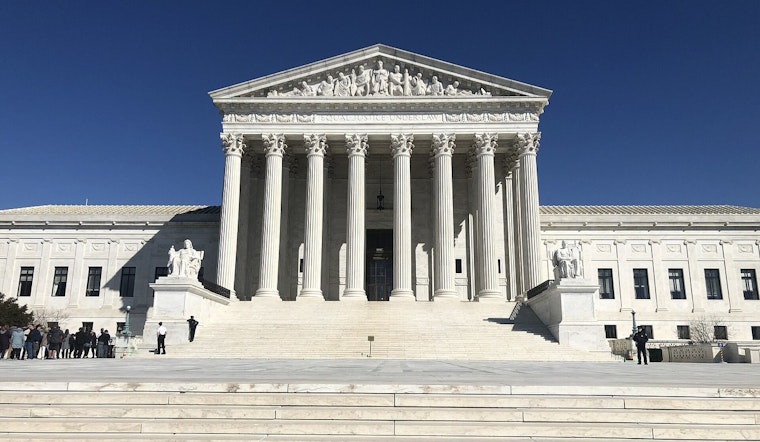
The Supreme Court on Friday cleared the way for a Mississippi street preacher to take another run at the city that arrested him for preaching outside a suburban amphitheater. Gabriel Olivier, an evangelical Christian, had been cited under a Brandon ordinance that confines demonstrations near the city’s amphitheater to a designated protest zone, then pleaded no contest and paid a fine. The justices’ ruling removes a procedural roadblock so Olivier can press a federal challenge seeking only forward-looking relief - an order stopping the city from enforcing the rule against him in the future - but it does not itself decide whether Brandon’s law violates the Constitution. The decision lands in a term where the Court has repeatedly taken up speech-and-religion disputes with big local ripple effects.
As reported by The New York Times, Olivier returned to the Quarry Park area outside the Brandon Amphitheater during a concert in May 2021, used a loudspeaker and at times held signs, and was told to move into a designated protest area. When he stepped closer to where concertgoers were walking, he was cited, later pleaded no contest in municipal court and paid a fine, and then turned to federal court to challenge the ordinance’s terms.
The Associated Press reports the justices took the unusual step of unanimously clearing Olivier to proceed, holding that a prior conviction did not automatically bar a suit that seeks only prospective relief. The outlet notes that the ruling opens the door for Olivier to seek an injunction but leaves for another day whether the ordinance itself runs afoul of the Constitution.
How the court handled Heck and prospective relief
At the center of the dispute was the Supreme Court’s 1994 precedent in Heck v. Humphrey and whether that rule keeps someone who was convicted under a law from bringing a civil-rights suit that asks only to stop future enforcement. The justices aired that issue at oral argument and in written filings on the Court’s docket, then ultimately allowed a challenge to go forward in this factual setting. See the Court’s filings and argument transcript for the Olivier matter on the Supreme Court docket for background and key exchanges at argument: Supreme Court.
What lower courts had said
The Fifth Circuit had earlier affirmed dismissal of Olivier’s federal suit, applying Heck to block claims that it said could imply the invalidity of his municipal conviction. In an unpublished 2023 opinion, the appellate court concluded that precedent in that circuit prevented Olivier from getting the prospective relief he sought. The reasoning is detailed in the court’s decision: Fifth Circuit.
What Brandon’s ordinance does
The challenged code provisions limit demonstrations in a mapped “restricted area” around the Brandon Amphitheater during events while keeping a separate designated protest area open. The ordinance text and district court filings describing the map and the protest zone appear in the underlying federal docket. The briefing also lays out how local officials described and defended enforcement. Those materials, including an ordinance excerpt, are collected here: Justia.
Why cities and civil-rights lawyers are watching
Municipal officials warned at the Supreme Court that a ruling favoring Olivier could invite a surge of suits attacking local rules, while civil-rights advocates argued the opposite - that people punished under a law should not be left with no federal forum to stop future enforcement. The Washington Post and other outlets have cast the case as part of a broader line of recent high-court decisions that sharpen the boundary between criminal convictions and civil remedies.
Next up is more procedure than drama: Olivier can now seek injunctive relief in federal court without the Heck bar automatically shutting the door, but the core question - whether Brandon’s ordinance violates the First or Fourteenth Amendment - still has to be litigated. Local governments are expected to defend the ordinance aggressively, and lawyers say the decision could clarify how courts handle future-facing claims by people with prior convictions under the same law. For a fuller narrative of Olivier’s arrest and the Supreme Court’s move, see The New York Times.





